Wooden boat plans: what's in the package and how to choose
Patterns, instructions and material lists, and what to check before you buy
If you are shopping for wooden boat plans, you are really choosing two things at once: the boat you want on the water, and the set of drawings you will be living with for the next year or more. The boat gets all the attention. The drawings decide whether the build goes smoothly.
This post is about the second part. What actually arrives when you buy a set of plans, how to read a listing before you pay, and how to tell whether a design suits a first build.
What are wooden boat plans?
Wooden boat plans are the designer's drawings, instructions and material lists for building one specific hull in wood. A good set tells you the shape of every structural part, the order to assemble them in, what timber and plywood to buy, and how to fasten it all together. Some sets also include full size patterns, which are paper templates you trace straight onto your stock.
That last part is the biggest difference between one set of plans and another, and it is worth understanding before you compare prices.
Full size patterns versus lofting
Traditional plans give you a table of offsets: a long list of measurements from which you redraw the hull at full size on a floor. That job is called lofting. It is a real skill, it needs a flat floor about as long as the boat, and a mistake there carries through every frame you cut afterwards.
Plans with full size patterns skip that step. The designer has already done the lofting, so you lay the paper on the plywood, mark through it, and cut. Glen-L Marine explain on their plans and patterns page that they started doing this because lofting alone put most beginners off, and that patterns now come with almost every one of their designs.
Even with patterns, not everything is drawn full size. On a frame-built boat the usual set covers the structural parts:
- The frames, often as half-section patterns that you flip about the centerline to draw the other side.
- The transom and the stem.
- Knees, the breasthook, and blocking where the chine meets the frames.
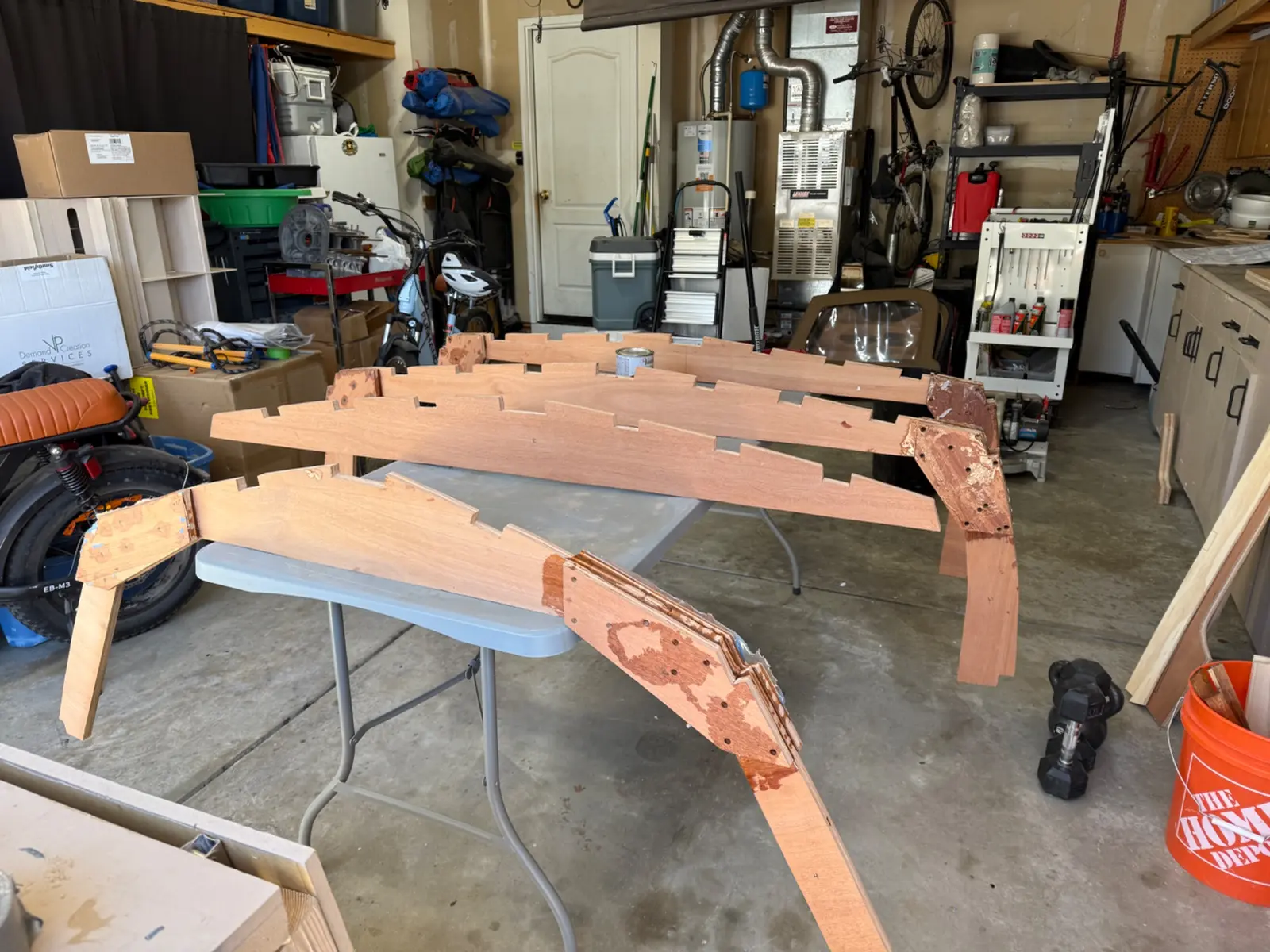
What you normally do not get is a pattern for the planking. Every hull comes out a little different once the frames are standing, so the frames themselves become the pattern: you lean a sheet of plywood against the skeleton and mark it to shape. Stitch and glue designs are the exception. There the panels are the structure, so the planking is usually patterned or given as precise panel dimensions too.
If you have never lofted a boat, patterns are worth a lot. They do not make you a better woodworker, but they remove a whole class of mistakes that happen before you have cut any wood.
What else should be in the package
Drawings on their own are not a build plan. When you read a listing, look for these:
- Step by step instructions. Not just the sheets, but written phases that take you from strongback to paint in a sensible order.
- A bill of materials. Every board and sheet, with the species or grade recommended. This is how you price the boat before you commit.
- A fastening schedule. Which screws, nails or bronze fasteners go where. On a frame-and-plywood boat this is a surprisingly long list.
- Specifications you can check. Length, beam, hull weight, recommended power and how many people she carries. A listing that will not tell you the hull weight is hiding something you need for the trailer.
- Rules about changes. Can the hull be stretched or shortened? Can you go up in power? A designer who answers these plainly has thought about the people building their boats.
The Glen-L listing for the Malahini is a fair example of a complete set. It names the patterned parts (stem, breasthook, transom knee, chine blocking, half sections for each frame and the transom), includes instructions, a bill of materials and a fastening schedule, and states that the hull can be shortened by up to 10 percent but not lengthened. That is the level of detail to hold other plans to.
How to choose plans for a first build
The most common way a first boat stalls is not bad drawings. It is a boat that was too big, too complicated, or too far from what the builder actually wanted to use. A few honest questions help:
- Where will she live and how will she move? If the boat lives on a trailer, the hull weight on the listing matters more than the length.
- How much space do you have? You need room to walk all the way round the strongback with a sheet of plywood in your hands. Measure the garage before you fall for a 20 footer.
- How many hours can you give it each week? Designers often publish an hours estimate. Treat it as a floor, not a promise, and compare it with real logged numbers on the build stats page.
- Frame built or stitch and glue? Frame-built boats teach you more carpentry and suit classic runabout lines. Stitch and glue usually goes faster for a small boat and needs fewer jigs.
- Is anyone else building one? A design with other builders behind it means photos to compare against and someone to ask when a drawing is not clear.
That last point is easy to check. Every design in the plans catalog shows the logs kept against it, so you can see who has built one, how far they got and what it looked like at each stage before you spend a dollar.
Reading the drawings once they arrive
When the plans land, resist the urge to start cutting. Spend an evening with them first.
Read the instructions all the way through, even the chapters on deck hardware you will not reach for months. Find the sheet that shows the building form or strongback, because that is your first job and everything else hangs off it being straight and level. Check the scale of each sheet and note which dimensions are full size. Then lay out the patterns and count them against the list in the instructions, so you find a missing sheet now and not halfway through the frames.
It also pays to start a log on day one, not when the hull is planked. Photos of the patterns laid on the plywood, the strongback before anything sits on it, the first frame half cut: those are the shots you will want later and the ones other builders search for when they are at the same stage. The build logs on this site are full of exactly that.
Plans are the start, not the finish
A good set of wooden boat plans takes the guesswork out of the shape. It does not build the boat. What gets a hull from patterns to paint is steady time in the shop and a clear picture of what the next step is, which is why the instructions and the material lists matter as much as the lines.
Pick a design that suits how you will use it, check that the package has patterns, instructions, a bill of materials and a fastening schedule, and look at who else has built one. Then order the plans, read them twice, and start the log the day you build the strongback.