Glen-L vs CLC: which is easier for a first boat?
Two ways into your first wooden boat, and what each one costs you
If you are about to build your first wooden boat, two names come up more than any others: Glen-L Marine and Chesapeake Light Craft. Both have been selling to amateur builders for decades. Both have produced thousands of finished boats. And they are not really the same kind of company, which is why "which one is better" is the wrong question and "which one suits the boat I want and the shop I have" is the right one.
Here is the honest short version. CLC is easier for a first-time builder, because the parts arrive already cut and the manual is extraordinary. Glen-L gives you a far wider catalogue and a much cheaper entry, at the cost of doing the cutting and the interpreting yourself. I have built one of each, so the rest of this is what the difference actually feels like in a garage.
What each company actually sells
A boat kit is a box of pre-cut parts plus the materials to join them. A boat plan is a set of drawings that tells you what shapes to make out of wood you buy yourself. That single distinction explains almost everything else.
Chesapeake Light Craft began in a basement in 1991 and now ships complete CNC-cut kits from Annapolis. You can buy plans from them, and many people do, but the kit is the main product and the designs are drawn with the kit in mind.
Glen-L has been established since 1953 and sells plans and full-size patterns for the amateur builder, backed by hardware and fastening kits for each design. For most of their catalogue there is no CNC-cut wood. You trace the patterns onto plywood and lumber and you cut the parts.
Neither approach is a compromise. They are answers to different questions.
The kit advantage: what CNC cutting removes
The Northeaster Dory is a 17 foot rowing and sailing dory with a 56 inch beam, a hull weight of about 100 pounds and a maximum payload of 800 pounds. CLC estimates roughly 120 hours to build, with the hull complete in as little as 80 and the sailing rig adding another 40. It uses their LapStitch process: pre-cut 6mm okoume planks stitched together with wire on a pair of ordinary sawhorses, with a 9mm bottom glassed on both sides.
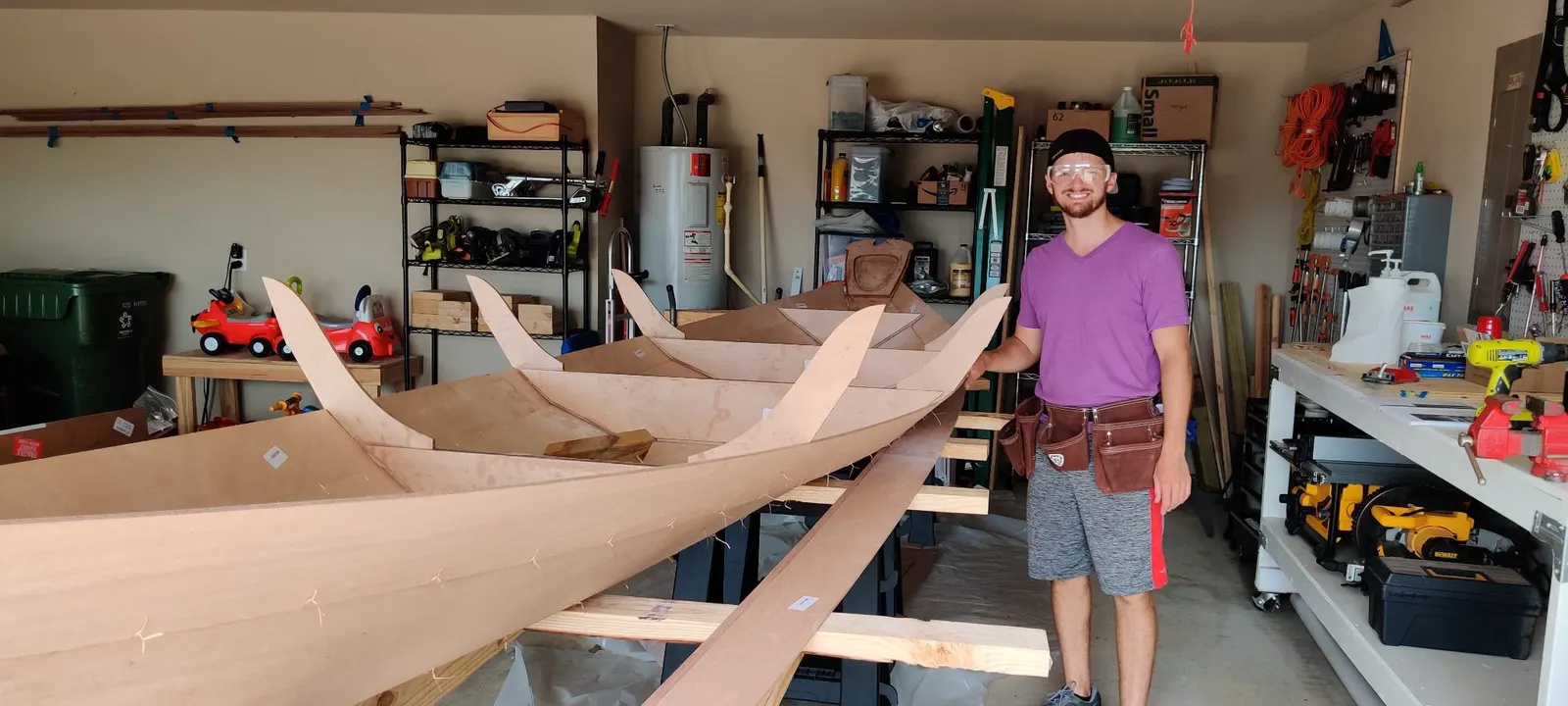
I built one of these over a summer, and the thing that stands out looking back at the log is how few of the seventeen entries are about making parts. They are about assembling panels, stitching, filleting, glassing, sanding and painting. The shape of the boat was decided by a machine before the box arrived. My job was to join it and finish it well.
That matters more than it sounds. A first-time builder has no calibrated sense of whether a part is right. When you cut your own frames, a quarter inch of drift is invisible until four parts later, when nothing lines up and you cannot tell which one is wrong. A CNC kit removes that entire category of doubt. If the panels do not meet, the answer is that you have them in the wrong order, not that you sawed badly.
The manual is the other half of it. CLC's Northeaster Dory manual runs 143 spiral-bound pages with every step photographed or diagrammed. That is not a pamphlet, it is a book about your specific boat. If you have never worked with epoxy, having someone walk you through each fillet in order is worth real money.
The plans advantage: choice, cost and the boats nobody kits
Now the other side. The Tiny Titan is an 8 foot 2 inch three-point hydroplane with a 4 foot 5 inch beam, a hull weight of 65 pounds and room for a short shaft outboard up to 20 horsepower. Glen-L describes it as an excellent beginning project, suitable for youths to build with a little help. It is developed for sheet plywood planking, and it costs a fraction of a 17 foot kit to get started on.
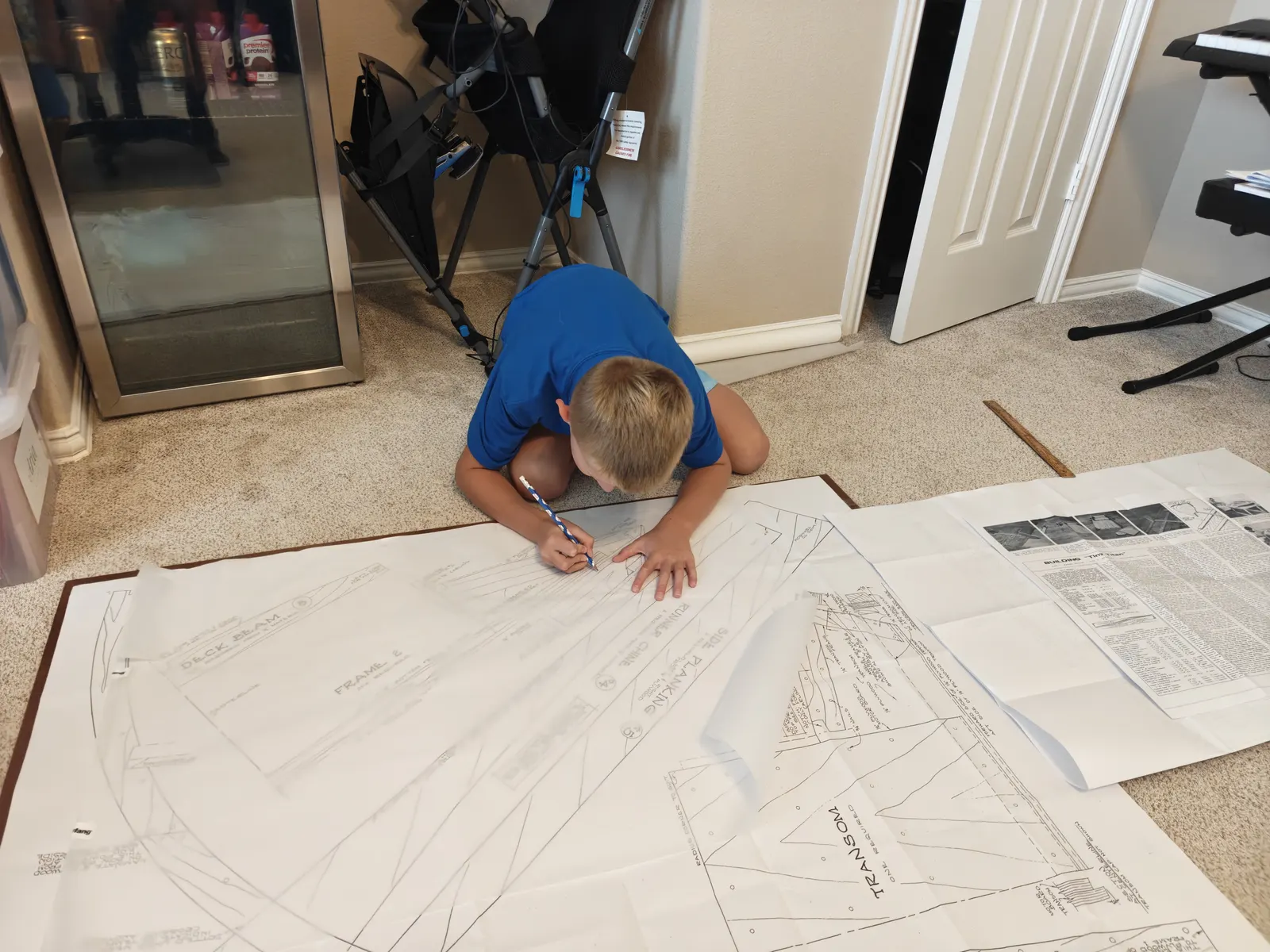
My Tiny Titan log reads completely differently from the dory. The early entries are tracing plans, buying the plywood, running lumber through a planer, prepping and cutting, cutting out more pieces, then fairing. Six entries in and I did not yet have anything that looked like a boat. That is normal for a plans build and it catches people out.
It is also where the mistakes live. I accidentally shortened the boat by two inches, and it went in the log because that is what a build log is for. On a kit, that particular error is not available to you.
What you get in exchange is range. Glen-L has been drawing boats since 1953 and the catalogue covers hydroplanes, runabouts, utility boats, dories, houseboats and more, in plywood, in fiberglass over plywood and in aluminium. If the boat you actually want is a 1950s style outboard runabout, no amount of kit convenience helps, because nobody kits it. Plans are the only door in.
Cost follows the same pattern. A set of plans and patterns is tens of dollars. A full kit is thousands. If your budget is the constraint rather than your time, plans let you buy plywood one sheet at a time as you go.
Be clear about what that does and does not save, though. The plans are the cheap part. George's Squirt log on this site records 78 euros for the Glen-L plans and close to 9,000 euros spent on the boat all told, because plywood, epoxy, stainless fittings and an outboard cost what they cost whichever door you came in through.
How to choose, in order
- Start from the boat, not the company. Decide what you want to do with it: row, sail, fish, go fast, take three people. Browse the designs on this site and look at what real builders picked for that purpose.
- Check whether that boat exists as a kit. If it does and you can afford it, and this is your first build, take the kit.
- Count your tools honestly. A plans build assumes you can cut accurately, repeatedly, to a line. If you do not own a decent saw and a way to fair a curve, a kit is cheaper than the tools plus the mistakes.
- Count your time, not just your money. Plans save cash and spend hours. Kits do the reverse. Be realistic about which one you have more of.
- Consider building a small plans boat first. An 8 foot hydroplane or a small pram is a cheap way to learn to cut, epoxy and fair before committing to a 17 foot hull.
The thing neither company can sell you
Whichever route you take, the part that decides whether the boat gets finished is not the kit or the plans. It is whether you keep going through the middle, which on both of my builds was sanding and fairing, and which is where most unfinished hulls in the world are sitting right now.
Builders who write down what they did tend to finish. Partly it is accountability, and partly it is that when you come back after a three month gap you can read what you decided and why, instead of standing in the garage trying to remember. Look at what other builders are up to and you will see the same pattern: the logs that keep going belong to the boats that get wet.
So pick the company that matches the boat you want. Then start a build log on day one, before there is anything to show, because the tracing and the plywood buying turn out to be the entries you most want to read later.