Jersey Girl is in hibernation for the winter, but while she sleeps her faithful...
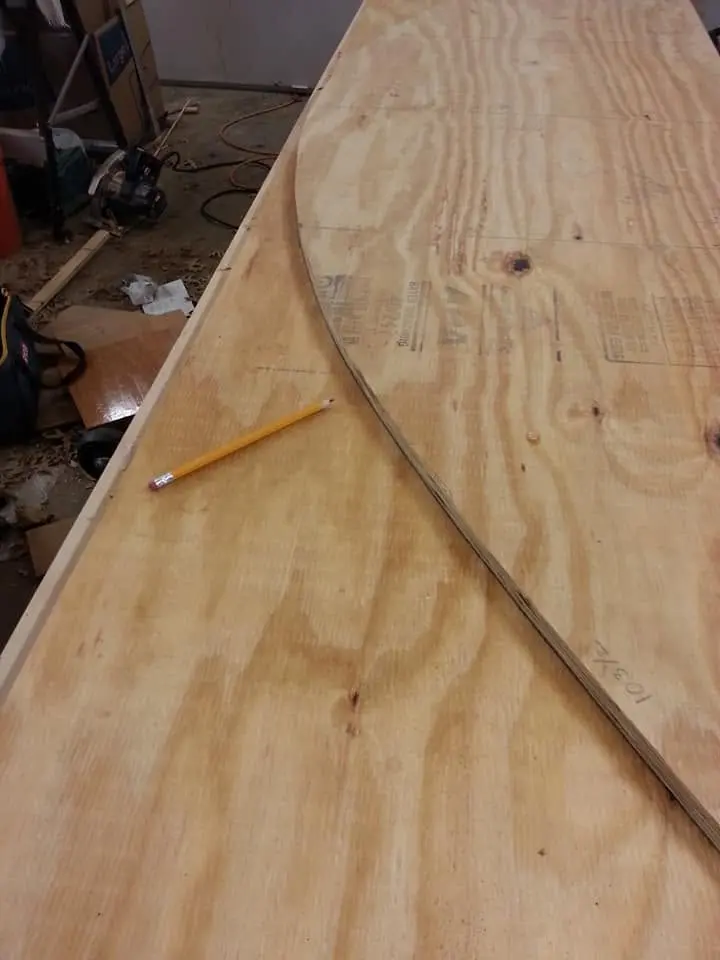
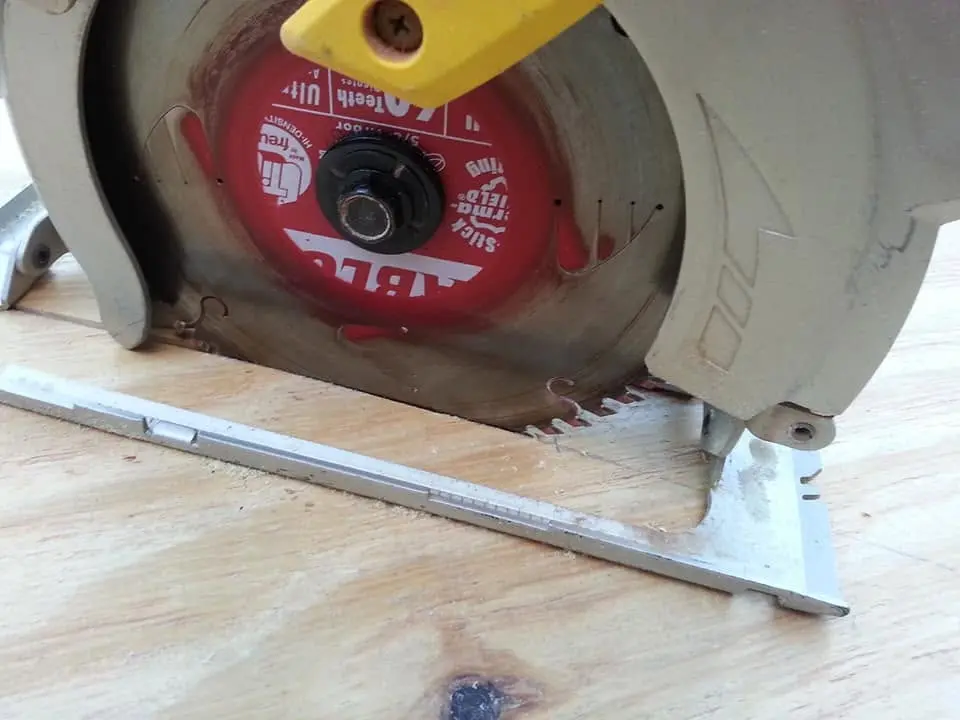
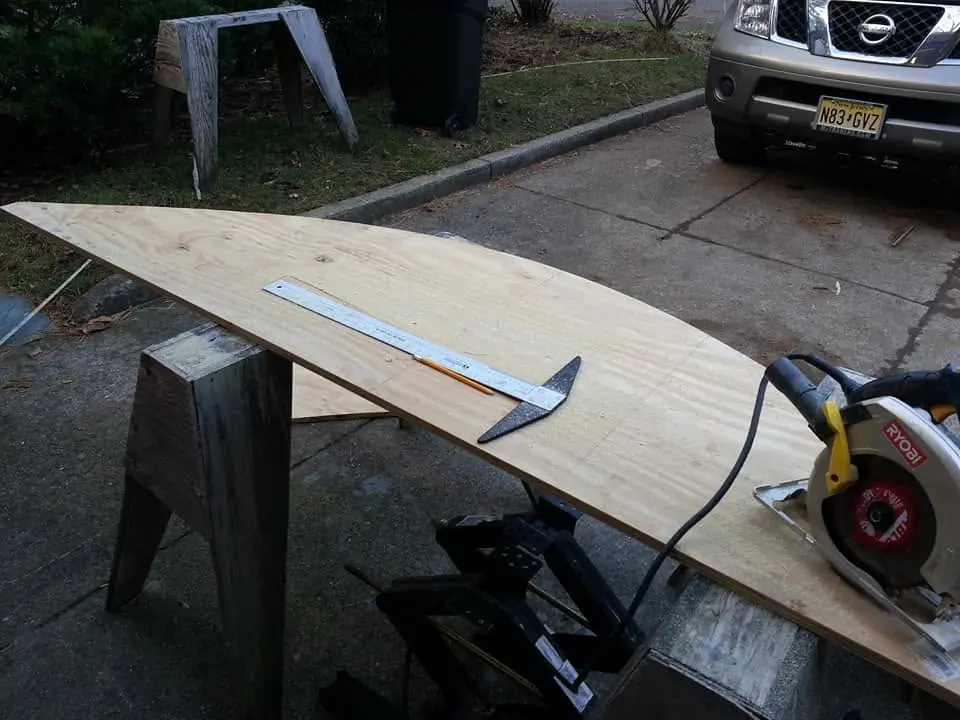
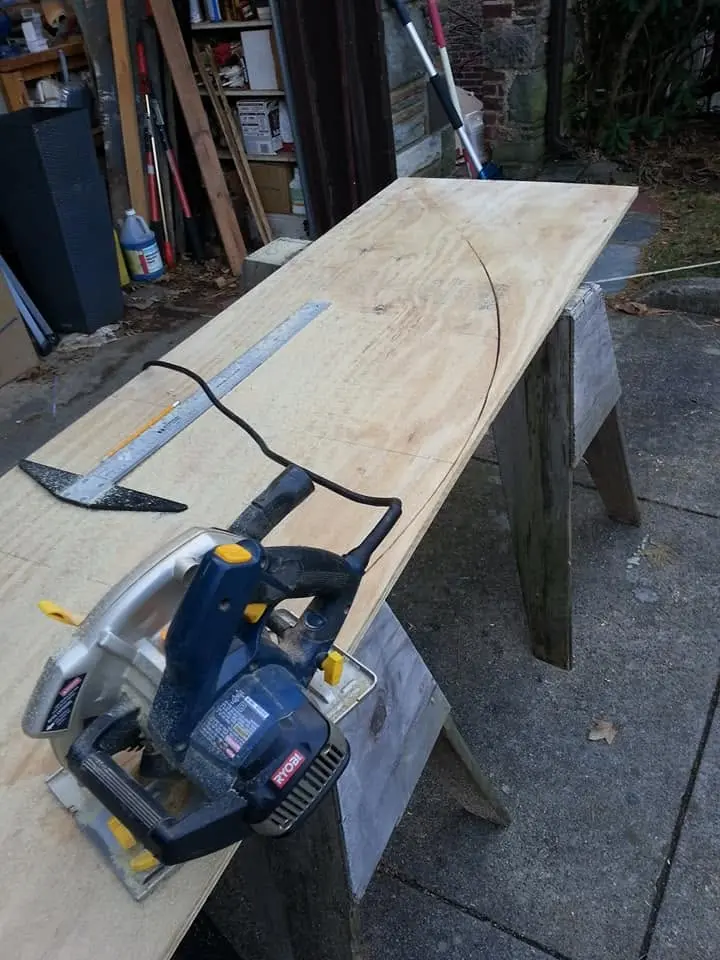
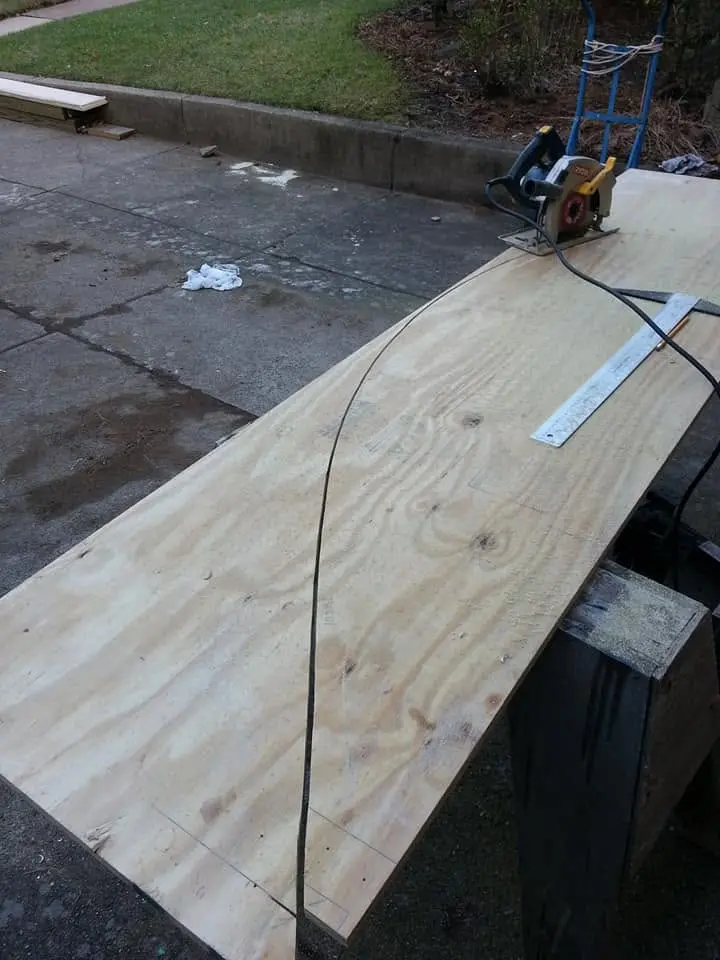
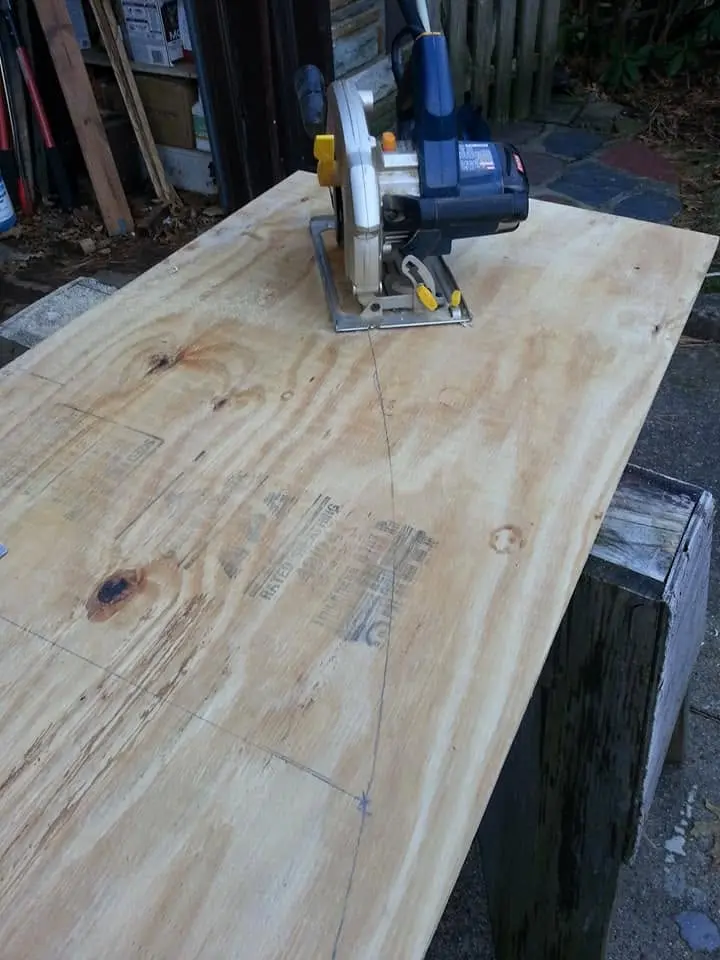
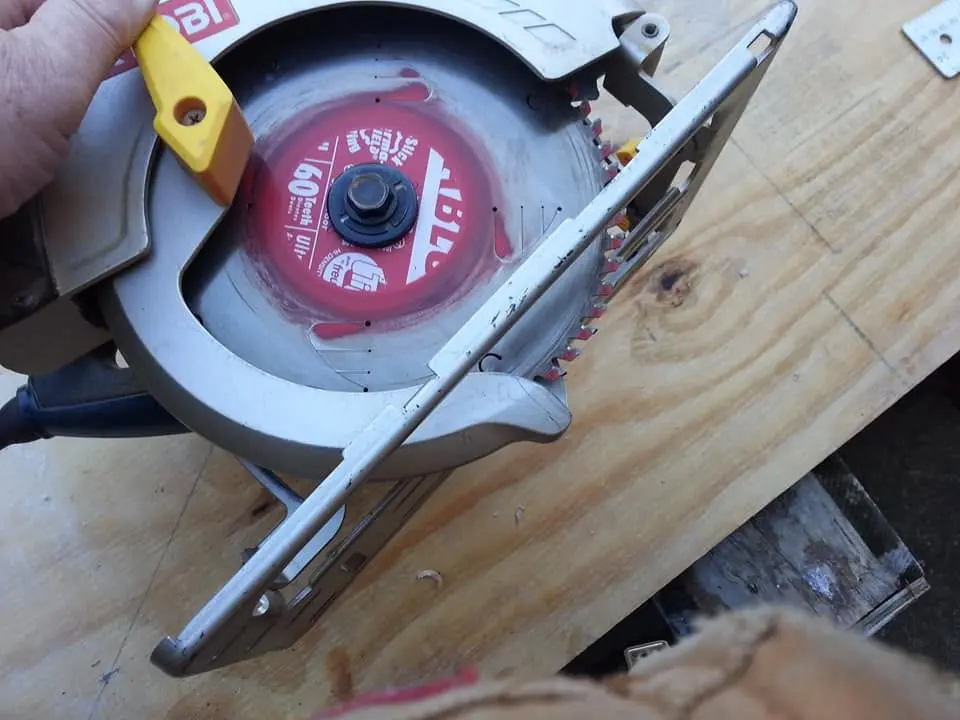
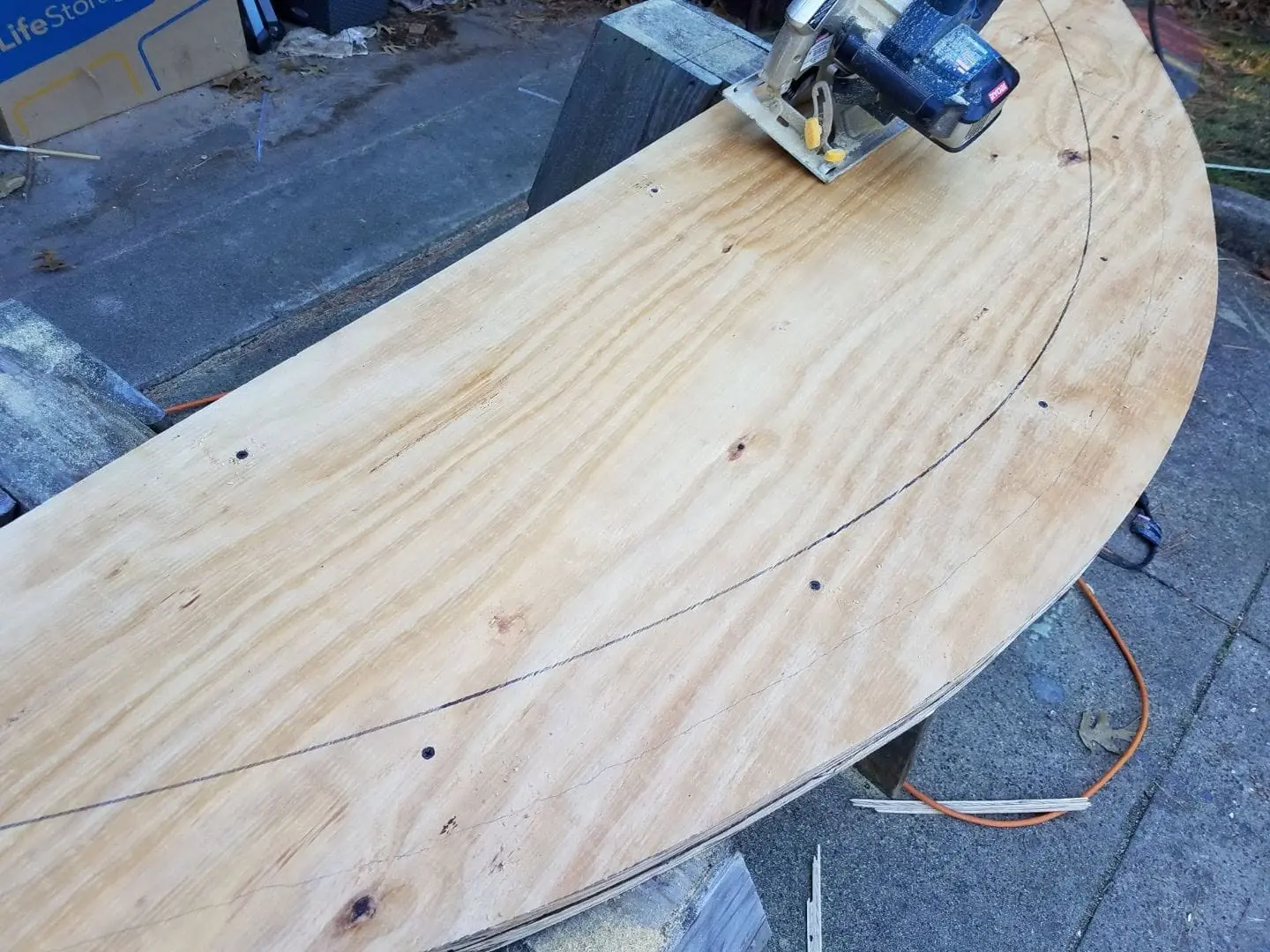
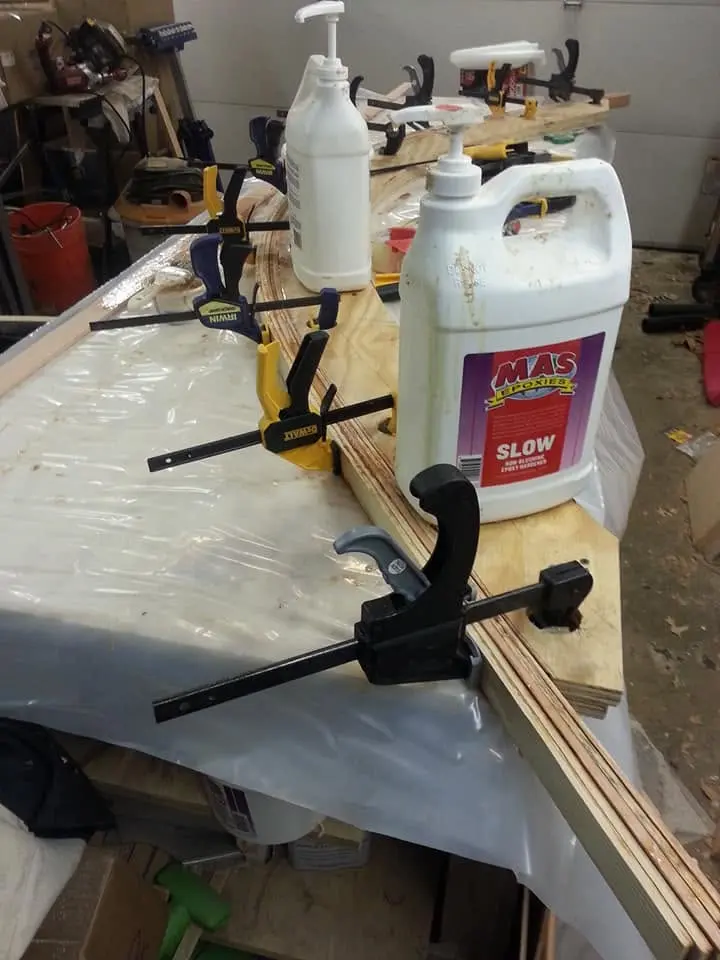
Houseboat update, Saturday, December 22, 2018 -- Jersey Girl is in hibernation for the winter, but while she sleeps her faithful builder is starting work on her Spring bonnet -- an arched roof that begins with symmetrically arched beams made of laminated cedar strips. The first step is to make a jig, a mold to set the strips against as I glue them up, the idea being to make all of them identical. The beams will be 1 1/2 inches thick, so I'm making the jig out of two layers of 3/4-inch plywood. The first step to get a nice fair arc was to establish a center line and decide the ultimate maximum height relative to the tops of the cabin side walls. Then, I used a batten -- a thin, springy length of knot-free wood -- to bend around the prospective top of the center line, between the two cabin sides. I traced around the inside curve of the batten to mark the line of the roof curve. I checked for symmetry by making a series of lines perpendicular to the base and measured out from the center line that I had established earlier. If the arc intersected at the same points on the correspond perpendicular lines, I would be satisfied; if not, I would start again. I made up my mind that I would consider variations of up to 1/16 inch "perfect." I needn't have bothered. They really were perfect. Next, I had to cut along that nice curve. From my earlier experience cutting the curve of Jersey Girl's bow, I knew that I could cut a perfect curve with a hand-held circular saw, if I set the blade at a depth of just a hair more than the thickness of the material. Any more than that and the chord of the blade that would be buried in the developing cut at any time would be too wide to effectively maneuver around the curve without binding and dangerously kicking back. As you can see from the pictures, I was able to cut exactly to the line, and my method worked perfectly. Next, I used the cut plywood as a pattern to trace on the second thickness.
Still working on the jig for Jersey Girl's laminated cedar roof beams.
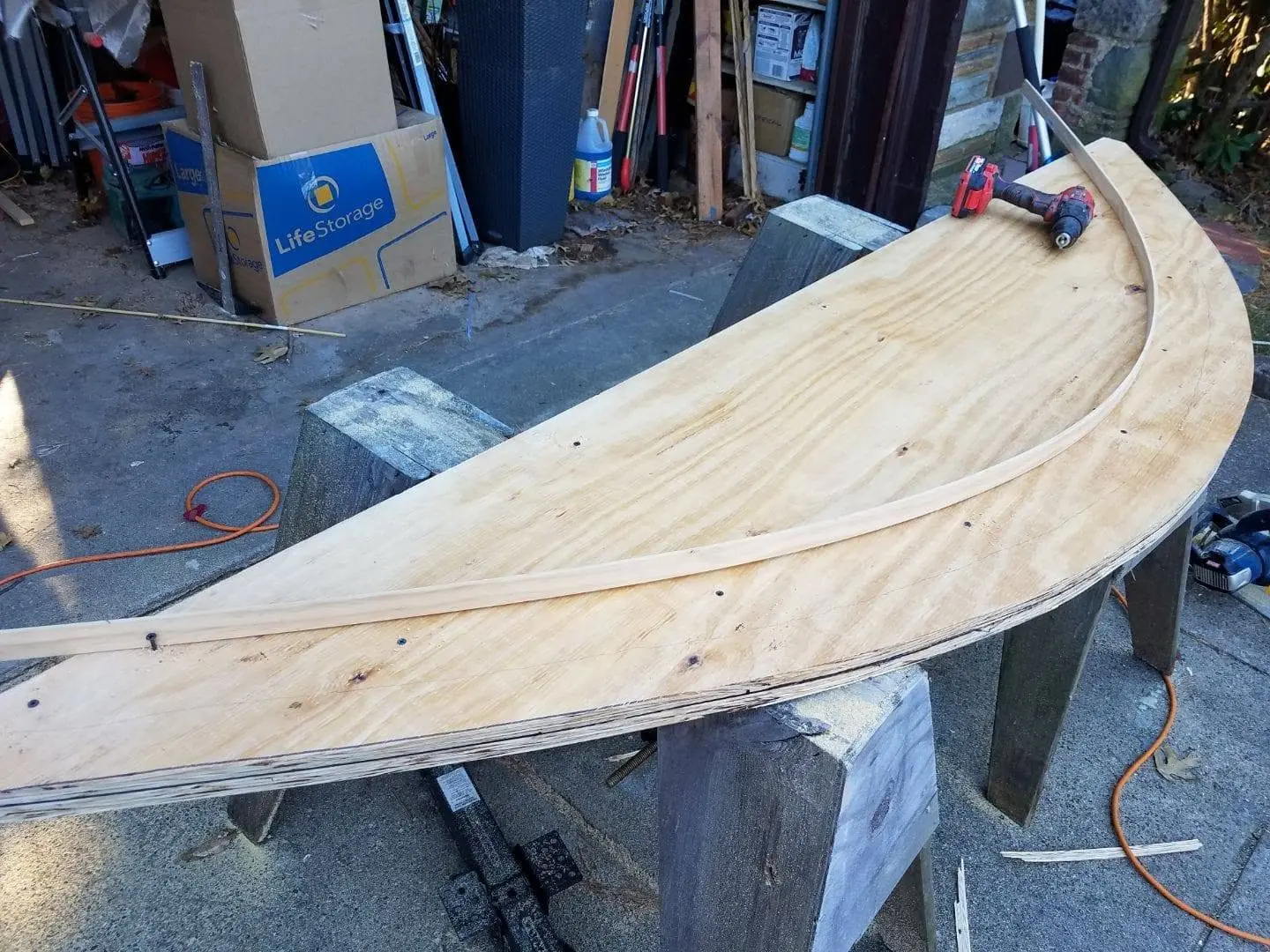
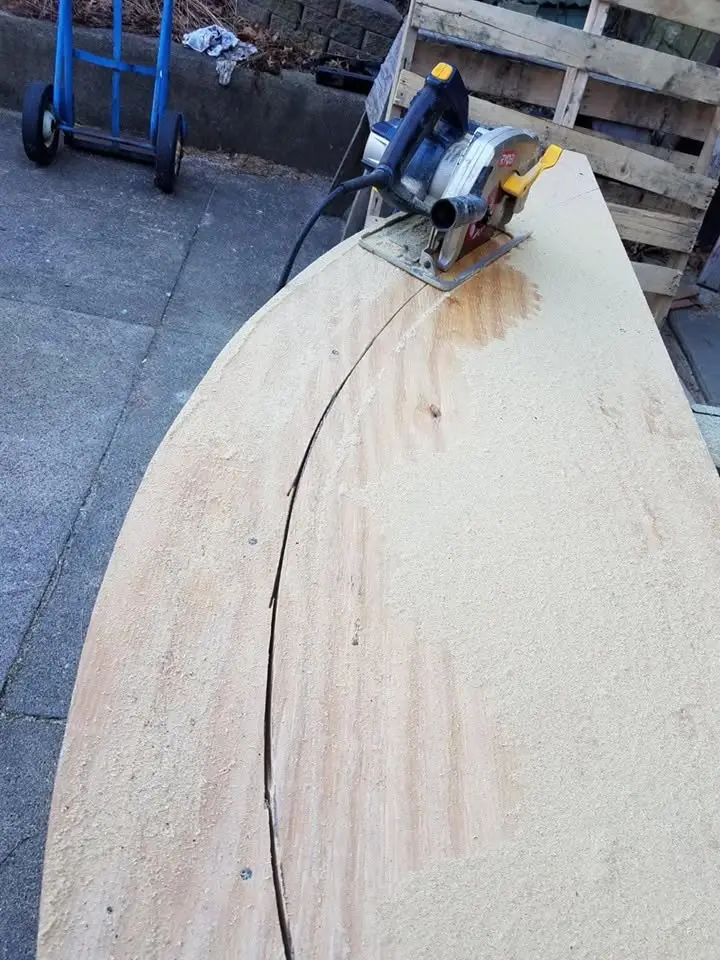
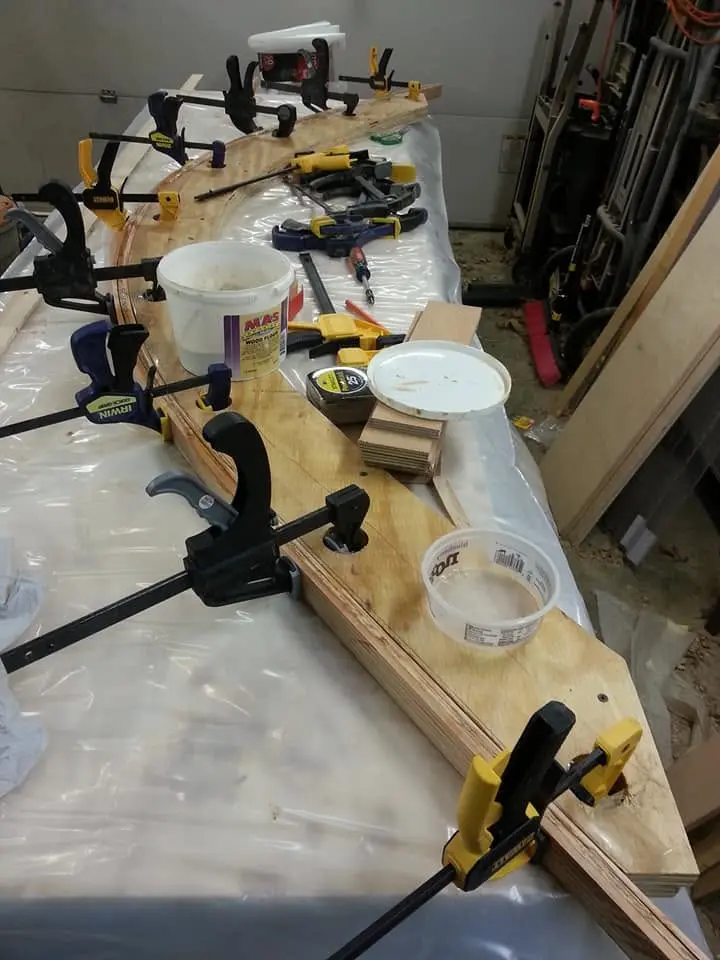
Houseboat update, Sunday, December 23, 2018 -- Still working on the jig for Jersey Girl's laminated cedar roof beams. Yesterday, I used the first arc, cut from a piece of 3/4-inch plywood to scribe the pattern onto a second piece of ply, to give me a 1 1/2-inch jig to build the laminate on. Today, I checked for symmetry by reversing the first cut arc and flopping it down on the second drawn arc, and discovered they were not quite symmetrical. So I drew a new line at the asymmetrical places, and cut along that line, then matched the new pattern up with the old and trimmed the edge of the old to match the new. Now, I had a jig that I'd be able to use, but I decided to cut away the unnecessary inside to make the jig easier to handle. After screwing the two pieces together so they wouldn't shift, I used the batten again to scribe a line where I'd cut. It didn't need to be precise, and that's a good thing. I learned that there is a practical limit to the thickness of the material I can cut on a smooth, accurate curve with a hand-held circular saw, and 1 1/2 inches is beyond that limit. I'd say 3/4-inch is about the thickest a circular saw can handle with precision. Even for someone who has built a few boats before, building a boat never ceases to be a learning experience.
I’ve started laying up the first of Jersey Girl’s arched roof beams against the jig I...
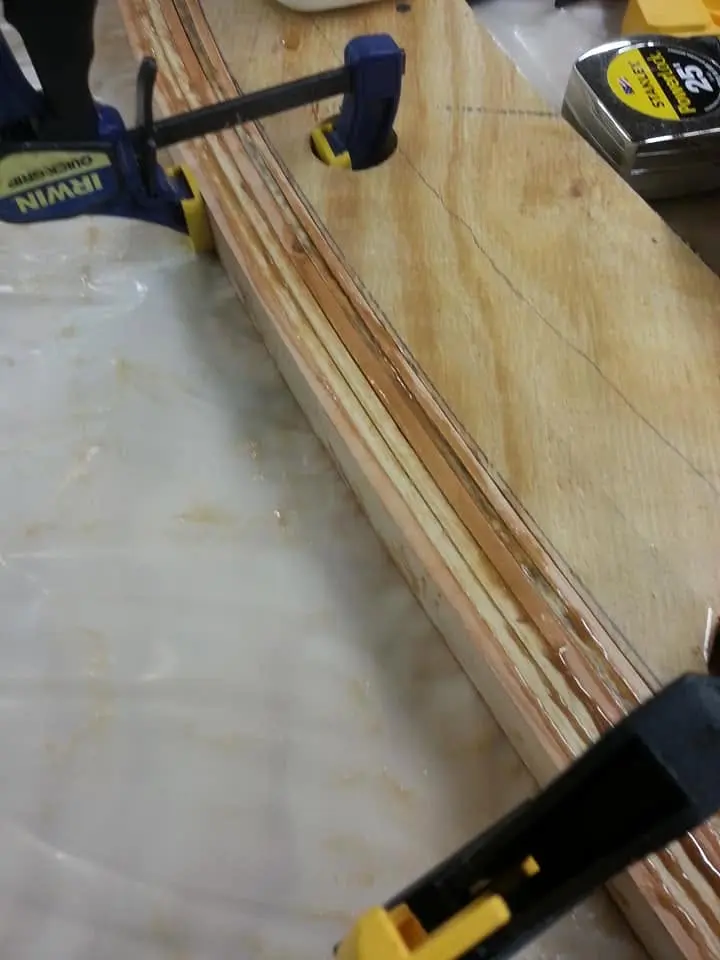
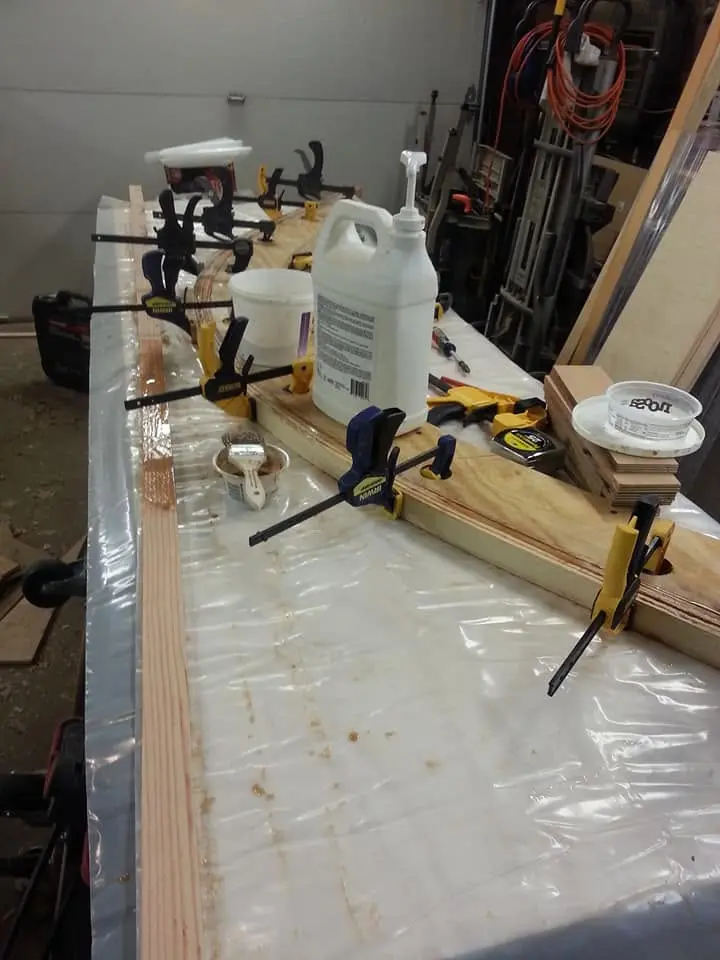
Houseboat update, Friday, December 28, 2018 – I’ve started laying up the first of Jersey Girl’s arched roof beams against the jig I made earlier. Each beam will be made of seven quarter-inch-thick by 1 ½ inches wide Douglas fir. I had planned to make these of clear cedar, but I simply could not justify the cost of turning that much high-priced cedar into saw dust, losing an eighth of an inch to the kerf with each pass of the table saw blade. So, I decided to go with plain old Doug 2-by-6 framing lumber. I looked for the straightest, most knot-free ones I could find in the stack of generally horrid crap at the competing big-box home centers, finally deciding that Lowe’s had the best selection. Knots and all, I bent them to the jig, laying them up with clamps and epoxy, a strip at a time. When each beam is fully cured, I’ll release it from the jig and plane down the edges to reveal an attractive laminate. To make certain I did not inadvertently glue the beam to the jig, I covered the edge of the jig with clear package sealing tape, knowing the epoxy will not stick to that. I alternated the strips from different boards to take advantage of the variation in wood colors, rather than have one beam all one shade and the next beam a different shade. I think it will look pretty good, and it will cost less than a tenth of the price of cedar – and that looks VERY good.
Here's Jersey Girl's first roof beam, released from its jig.
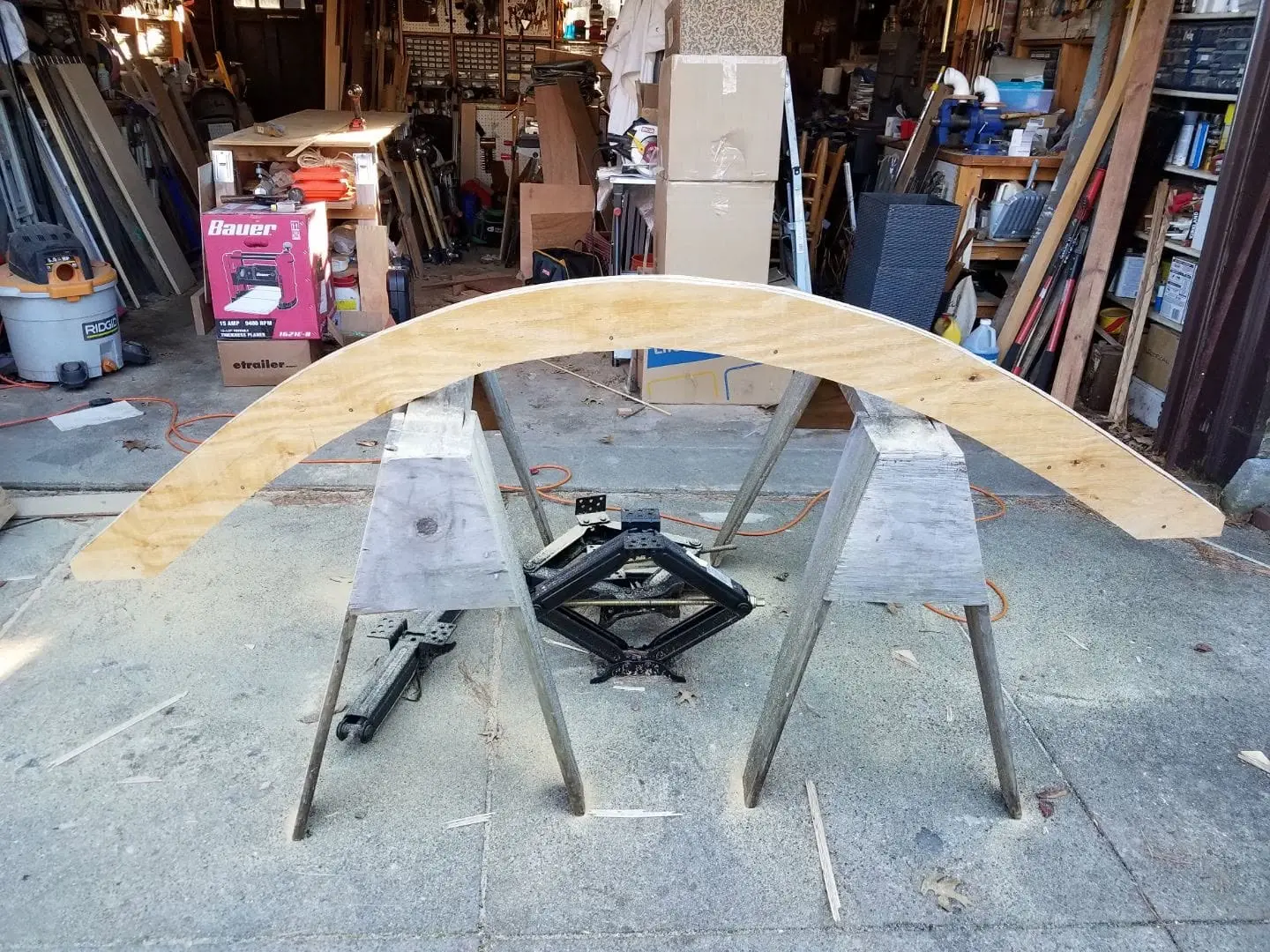
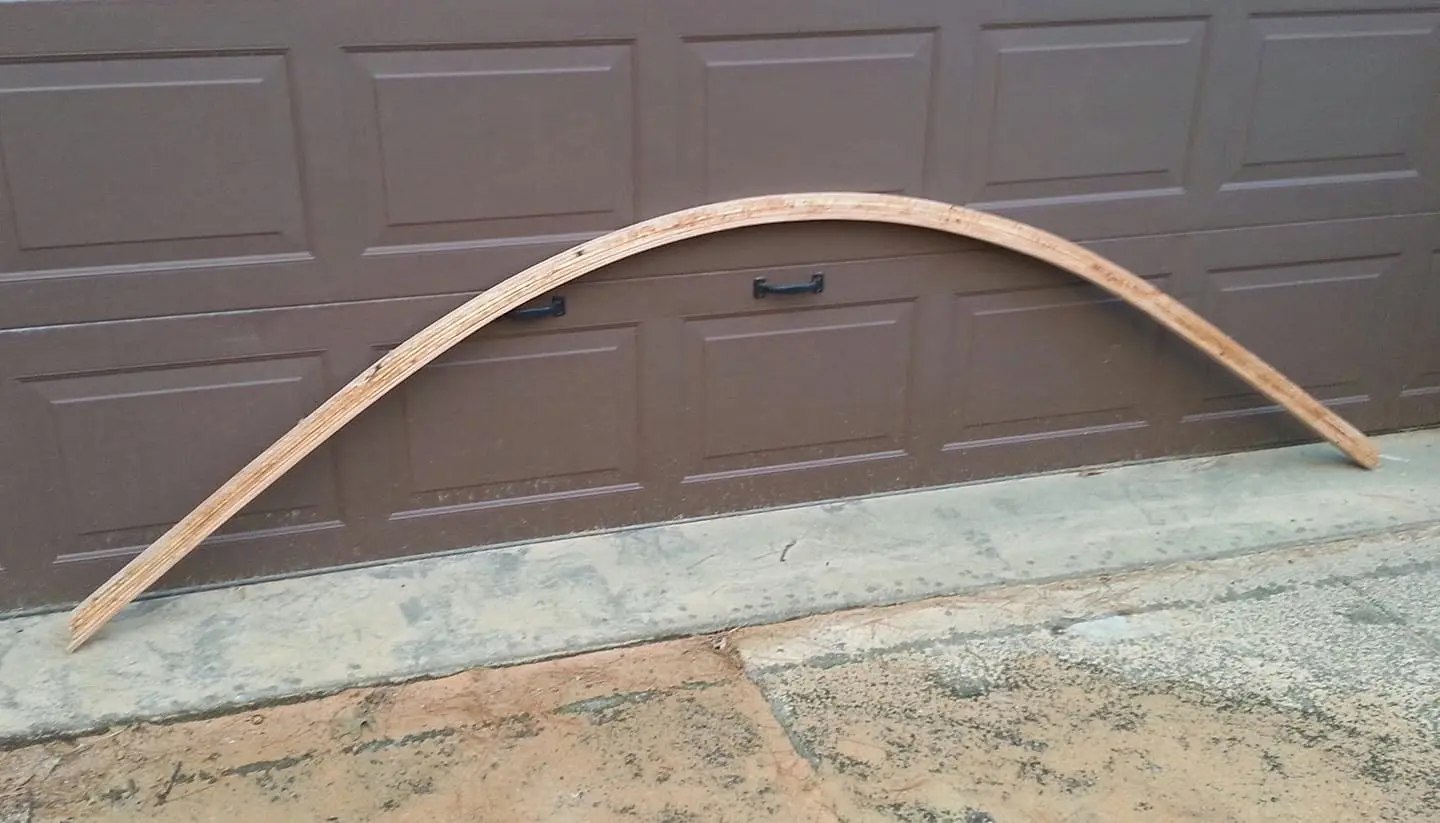
Houseboat update, Saturday, December 29, 2018 -- Here's Jersey Girl's first roof beam, released from its jig. It's made of seven quarter-inch thick strips of Douglas fir, sawn from ordinary 2 x 6 framing lumber from the local big box home center. In all, there's less than three dollars worth of wood in this, and about the same amount in epoxy. I didn't know what to expect in spring-back when I released it from the jig, and I was pleasantly surprised to see it flatten out by less than a half inch over its full eight-foot span. Not only that, it's very light and very strong. This will work!
It's back to the drawing board for Jersey Girl's roof.
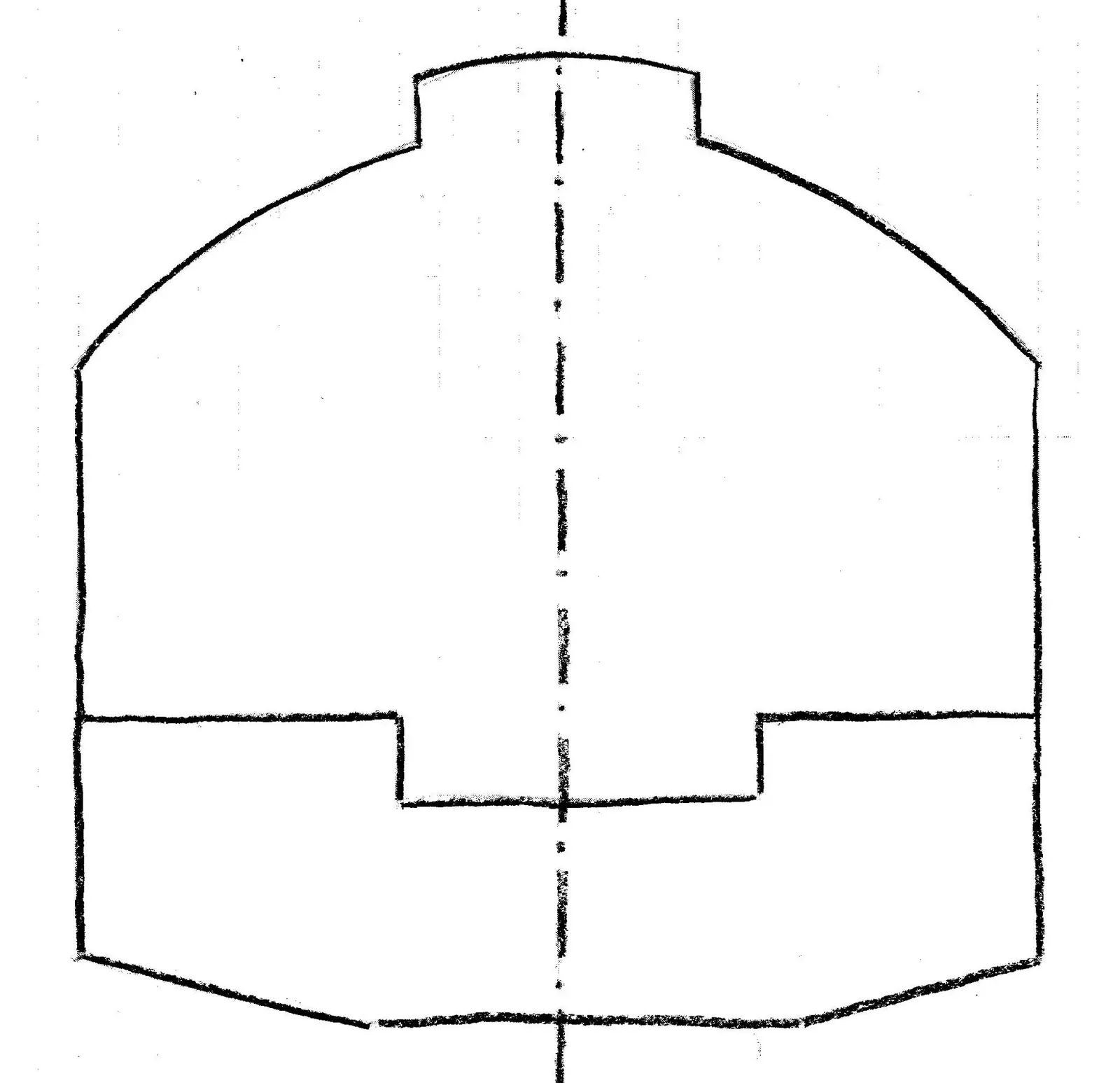
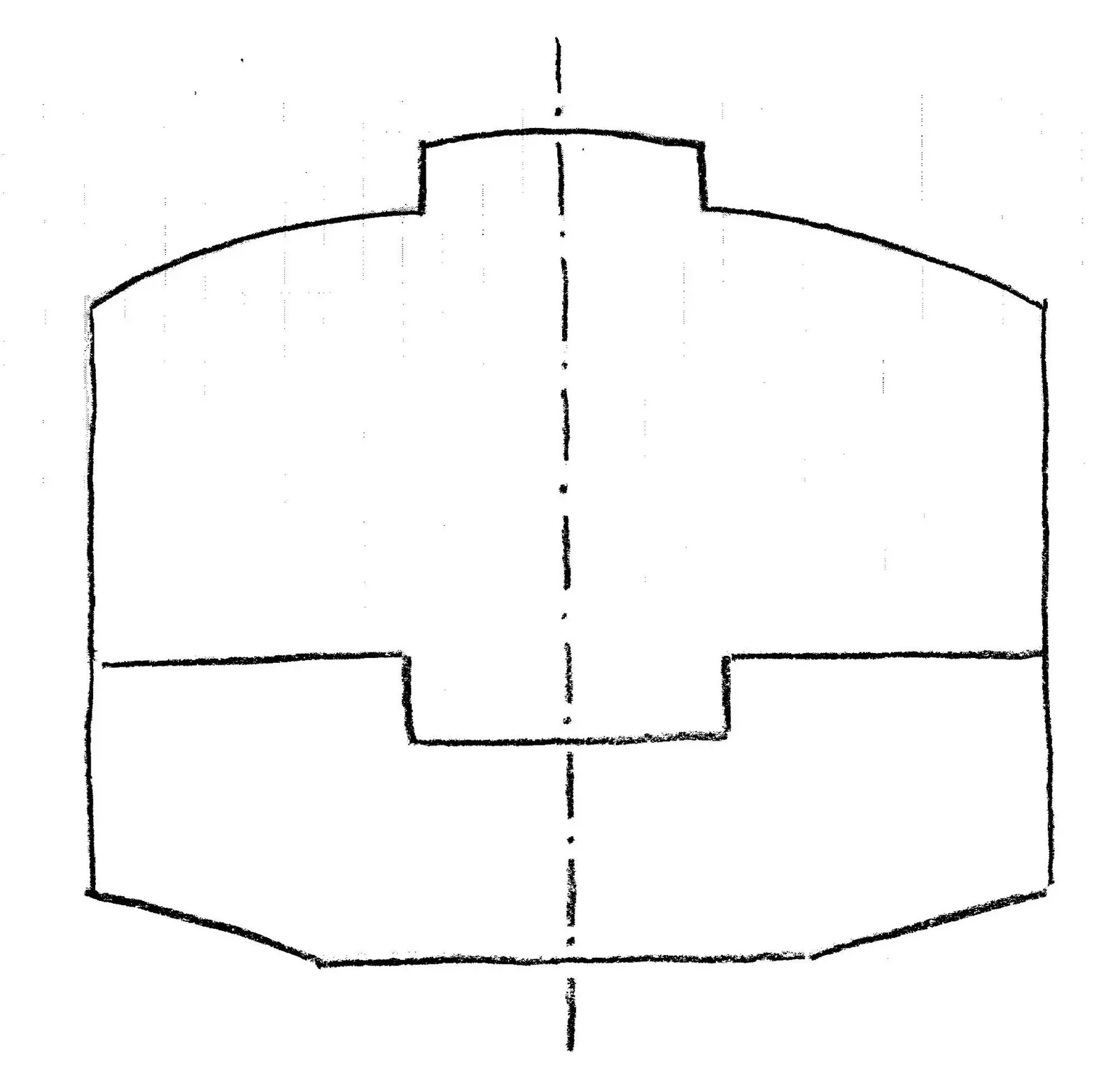
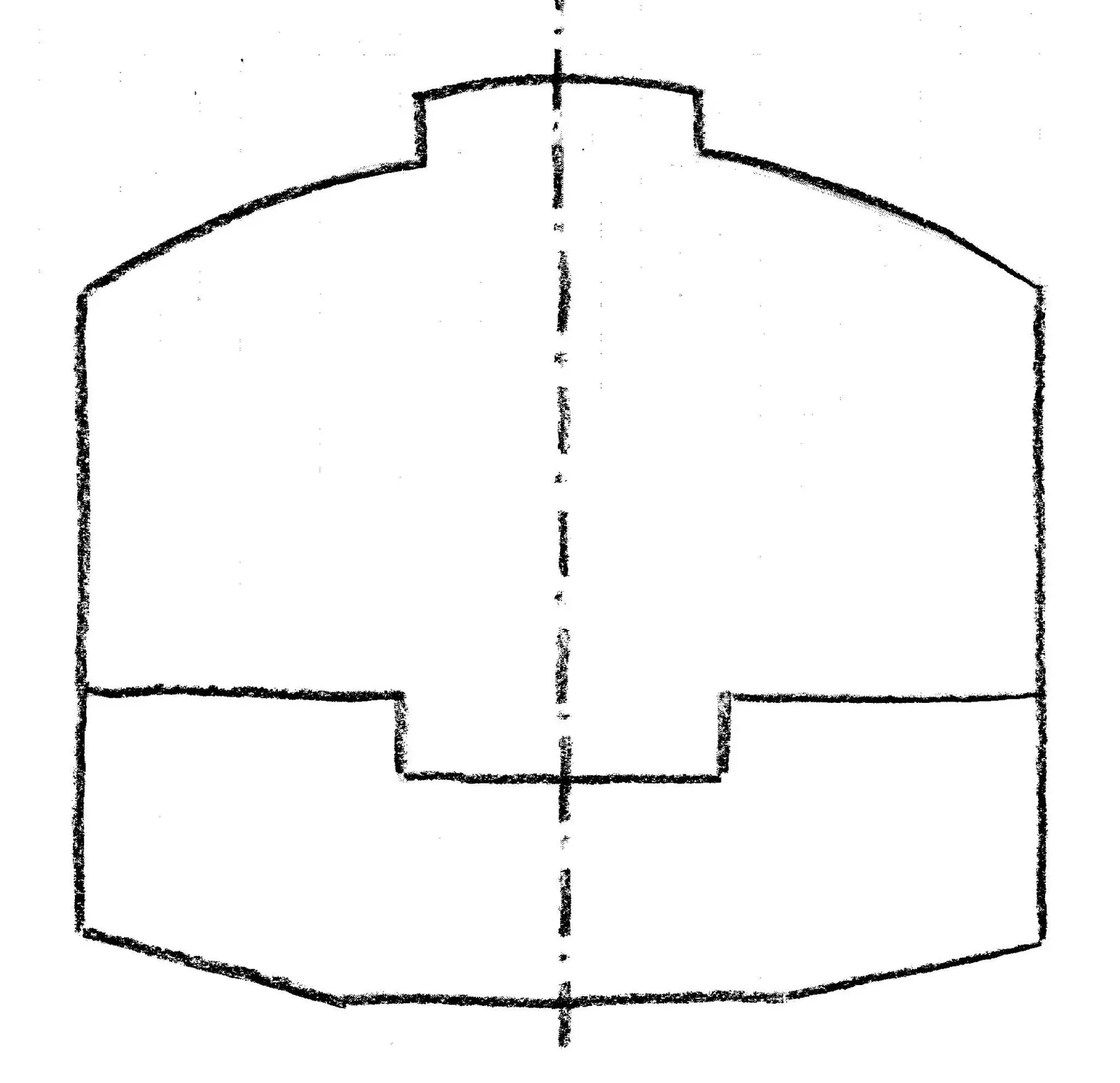
Houseboat update, Sunday, December 30, 2018 -- It's back to the drawing board for Jersey Girl's roof. My first attempt at design change, resulting in the dramatic, high-crown arch I published yesterday, does not do justice to Roy Schreyer's original design, I've concluded. My aim was to raise the headroom by about a foot, to allow more comfortable standing space on the aft deck, for entrance into the cabin and for showering. I still want to do that, but there's an aesthetically better way, I think. In the original design, the cabin sides are about 35 inches from the deck to the start of the roof, and the deflection of the roof arc was about 12 inches from horizontal (with additional headroom gained by raising the central portion of the roof), as seen in the first sketch. In my prior modification, I gained all the extra headroom I wanted by leaving the height of the cabin sides the same, but increasing the deflection of the arc to 22 inches, as seen in the second sketch. Not only do I think that looks disproportionate and ungainly, but it will also make walking on the roof, if I ever have to for any reason, rather risky. So I've decided to scrap the jig I've built and the first beam I've laminated, and start this part over again. As illustrated in the third sketch, I'm raising the cabin sides by 9 inches, to 44 inches, and setting the deflection of the roof beams at 15 inches. Not only does that look better and make the roof less dangerous to walk on, but it allows for taller windows in the cabin, for more light and better enjoyment of passing scenery. I'll start work on this modification during the first week of the new year. Happy New Year, everyone!