Jim Norman's 20 foot houseboat, built in his northern New Jersey driveway from 2015 to 2021. The design started from Roy Schreyer's Dianne's Rose, stretched three feet and reworked into his own. Okoume plywood hull over sawn frames and bulkheads, a cabin of cedar posts and laminated roof beams sheathed in pine beadboard, and a fiberglassed arched roof with gull wing panels over the aft deck. Launched on the Hackensack River in May 2021, she now cruises Lake Hopatcong, where she took the Ladies' Choice award at the 2024 antique and classic boat show.
Make a book
Feed
The whole log, 191 entries and every photo,
laid out as a book to print, bind and keep.
I’m beginning to get a bit of Jersey Girl’s roof in place, and I think it’s working...
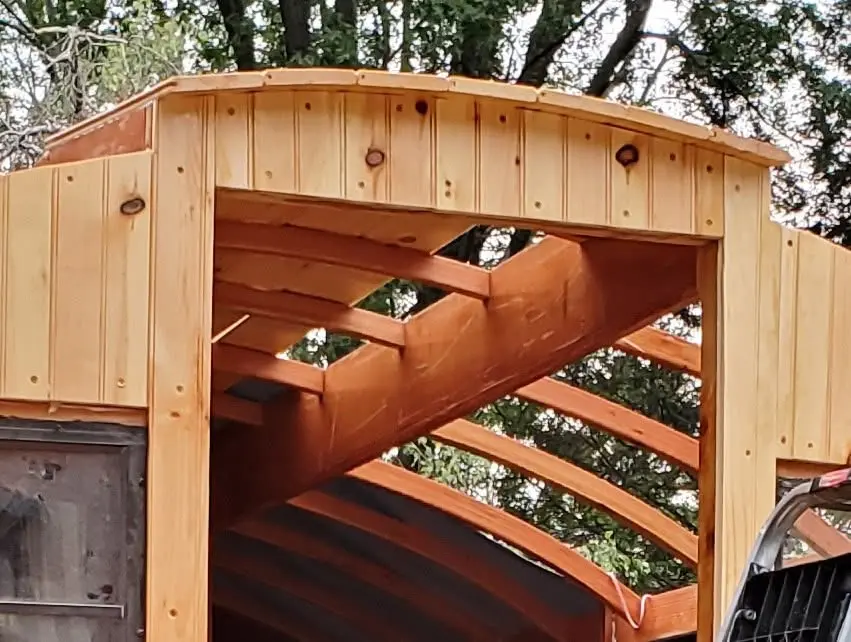
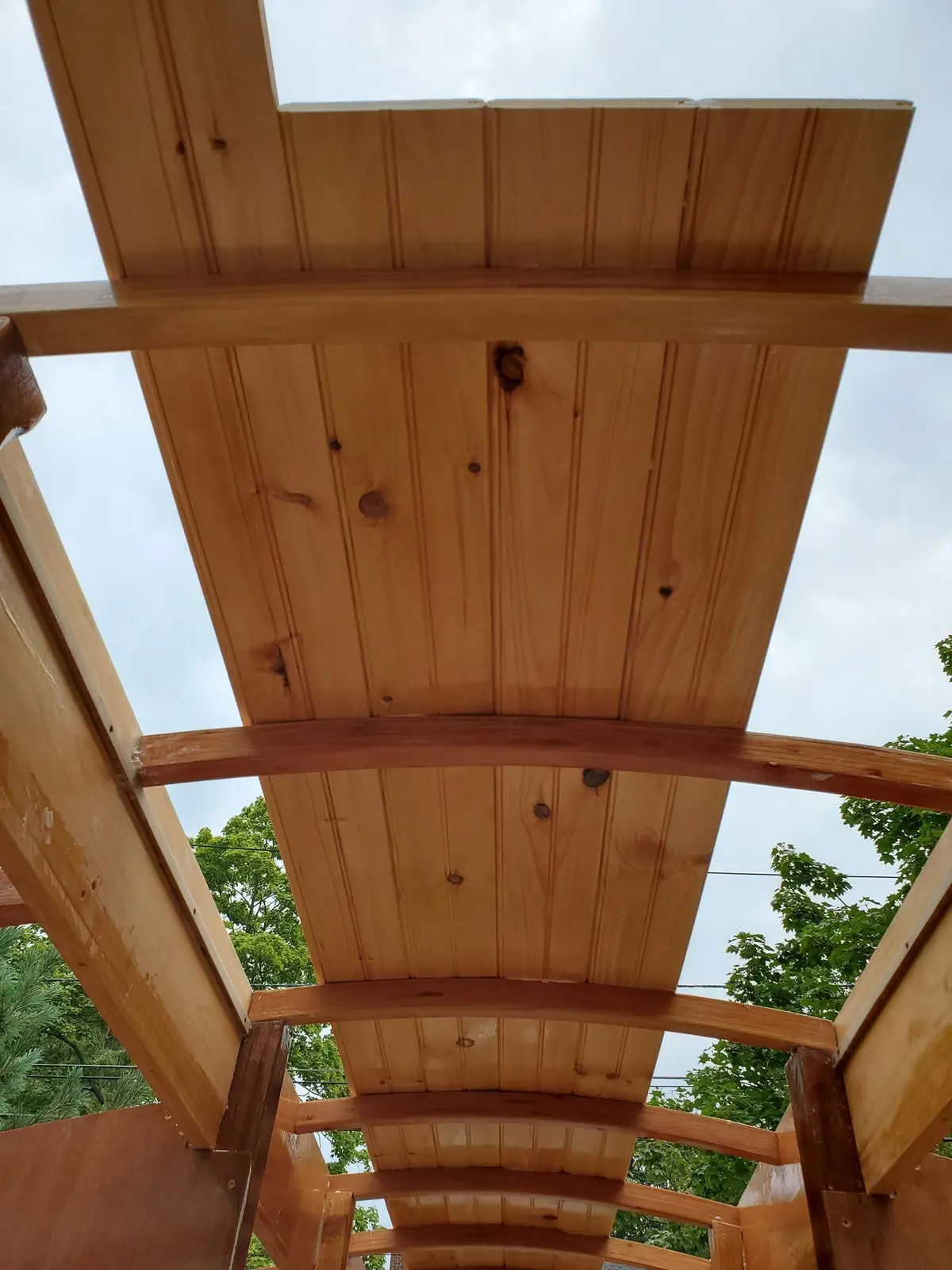
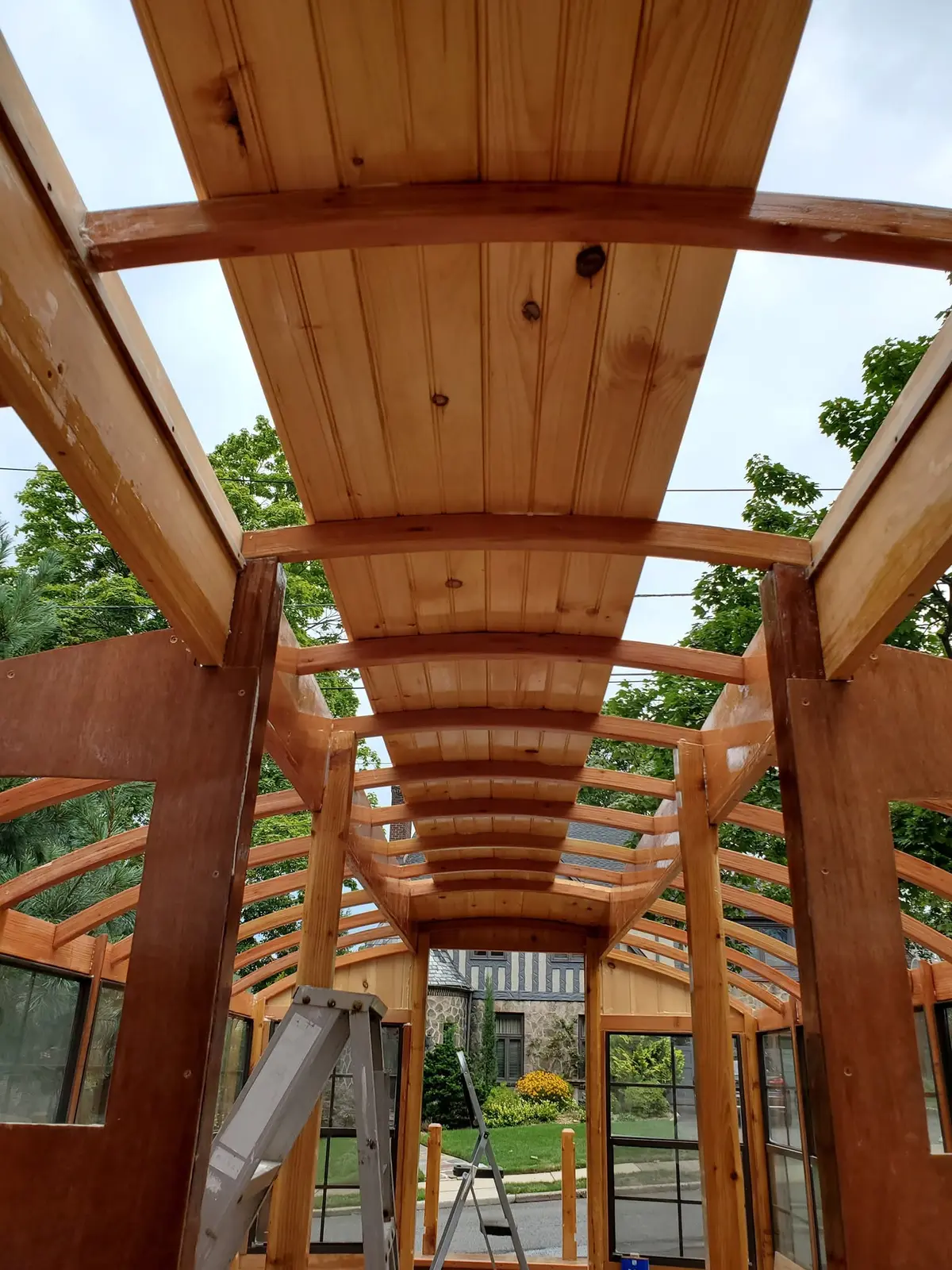
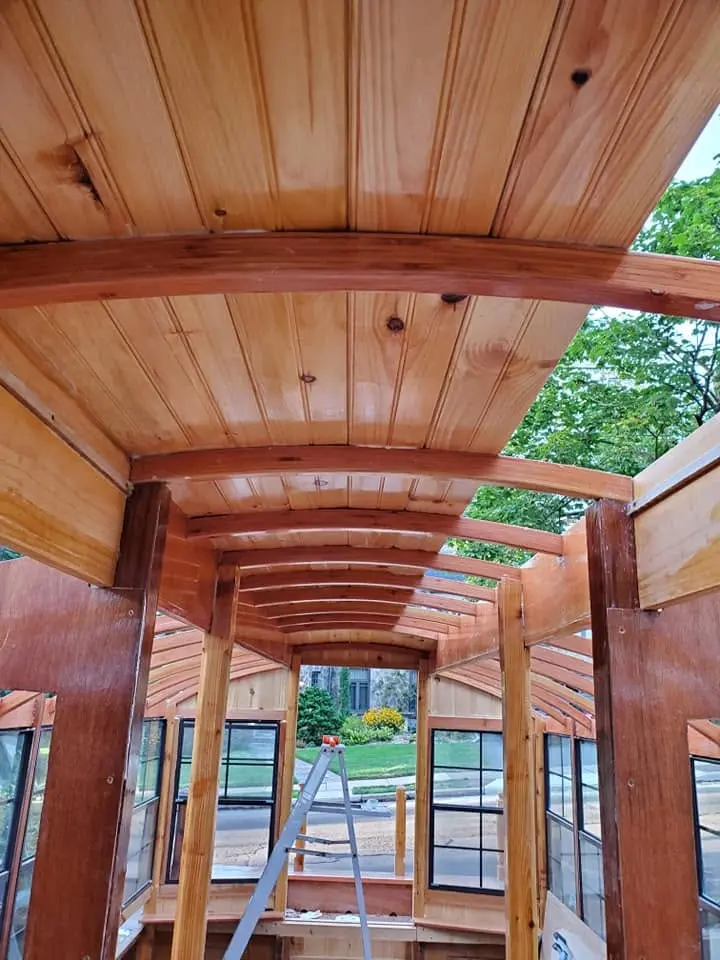
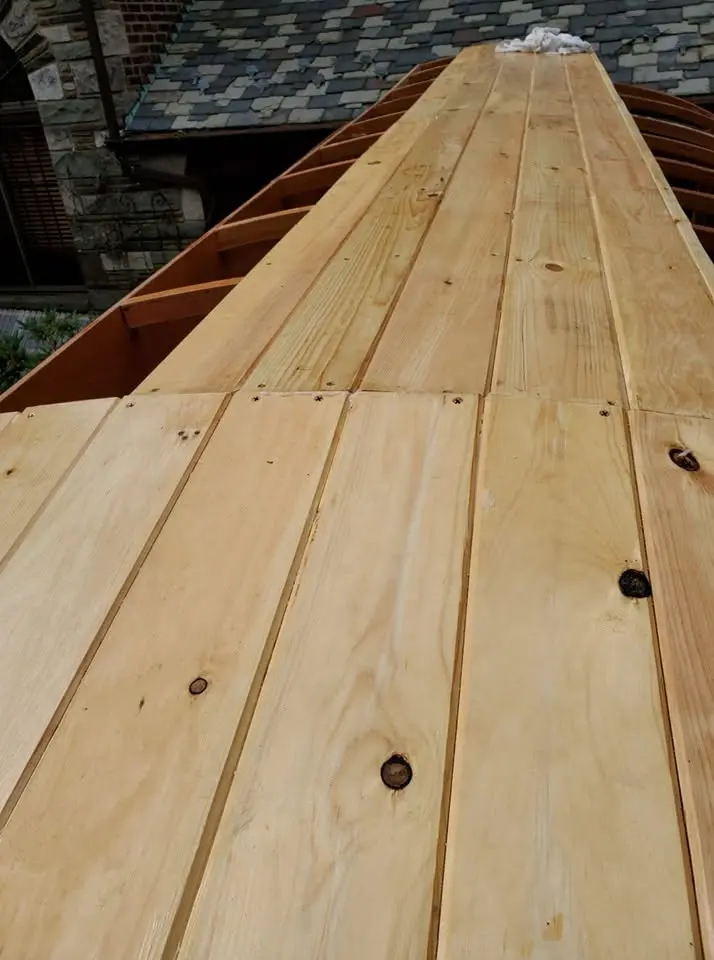
Houseboat update, Tuesday, August 13, 2019 – I’m beginning to get a bit of Jersey Girl’s roof in place, and I think it’s working out quite nicely! I’m using ¾-inch tongue and groove pine, milled to show a beaded wainscoting pattern on one side, what some people call “bead board.” Before I install each plank, I seal it topside and inside with two coats of epoxy, then set it up temporarily for fitting, drilling and countersinking pilot holes. I put a pencil mark on the topside of each rafter to show the limit of where I’ll spread glue, then take the board down and cut it to the exact length. Finally, I spread thickened epoxy on the tops of the rafters, put the board down where it belongs, and screw it into place. Sometimes, I find I need to persuade the tongue of a board to fit into the groove of the full eight-foot length of an adjacent plank with a good deal of force. I choose not to whack away at it with a hammer! Instead, I temporarily screw down the plank at the end that fits, then, about two-thirds along the length of the board I protect both the tongue and the even-more-fragile groove with form-fitting scraps cut from similar stock and use a long bar clamp (the screw kind, not the ratchet kind) to apply gradual force until I get a snug fit. I leave the beaded side of the board showing on the inside of the cabin roof, knots and all, making for a nice rustic cottage look. I’m leaving overhangs at the forward and aft ends of the roof, just because I think it looks nice. At the aft end, rainwater will drain off the roof directly into whatever body of water Jersey Girl is floating in (or the road, if she’s on her trailer). At the forward end, the overhang will serve as a drip-cap, preventing water from running down the forward cabin bulkhead and finding its way inside, past window and door frames. From the forward deck, it should find its way to any of the four deck drains, and flow through the under-deck drainage piping to either of two scuppers on the port and starboard sides. More about patience: I find I don’t really have to make a choice between patience and impatience, or between instant and delayed gratification. Instead, I find a balance – immense satisfaction at each stage of the building process. It might not work for everyone, but it seems to keep me content.
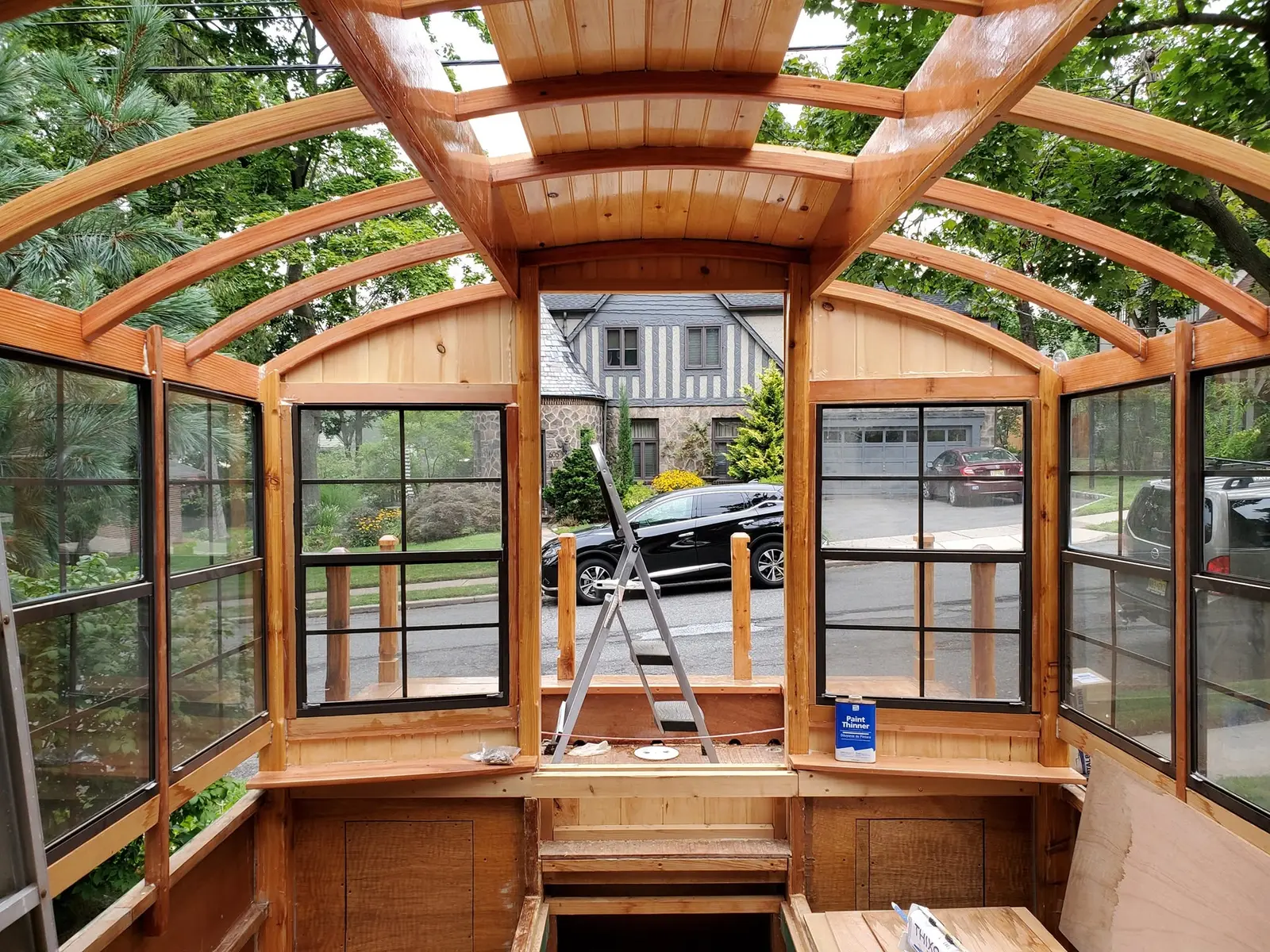
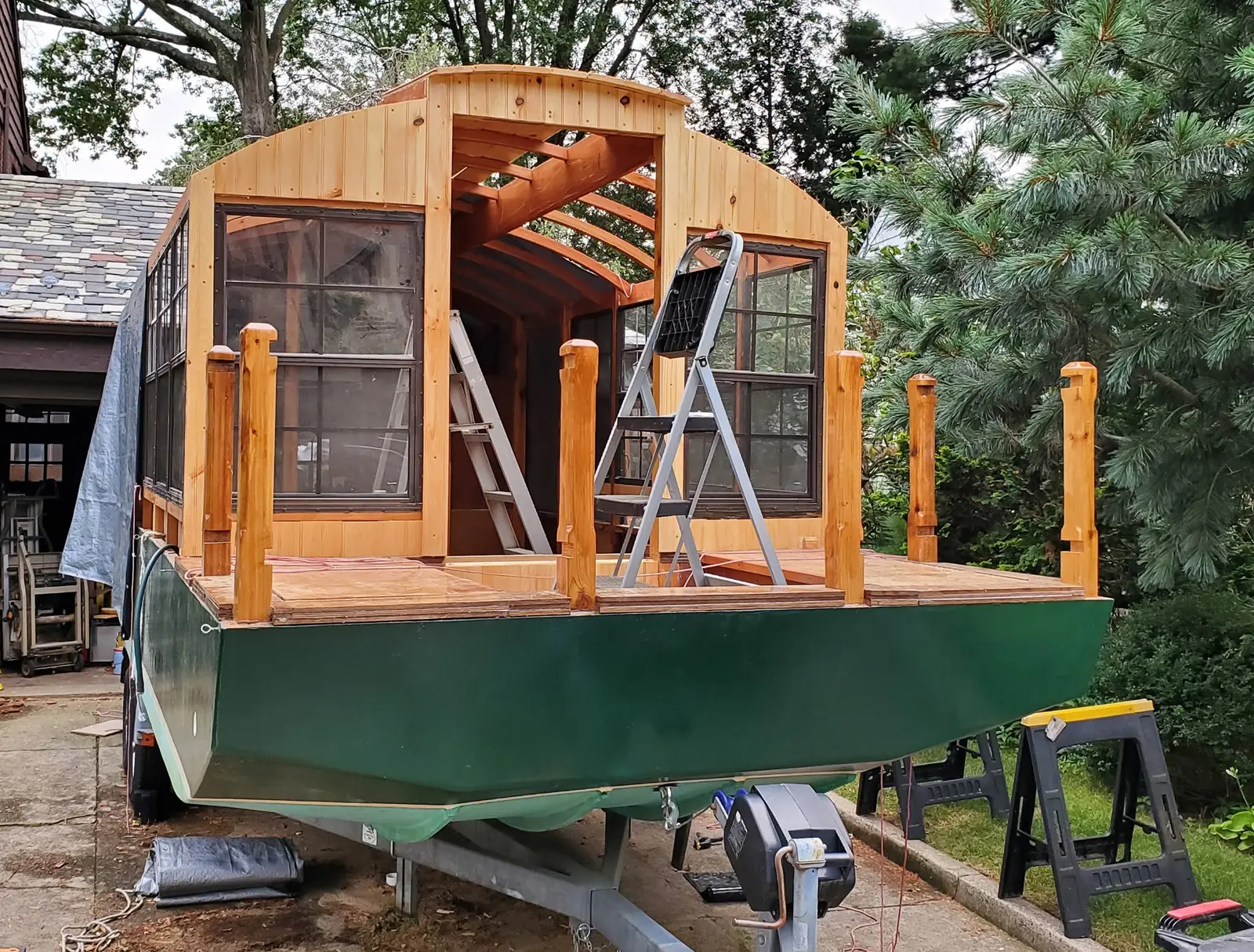
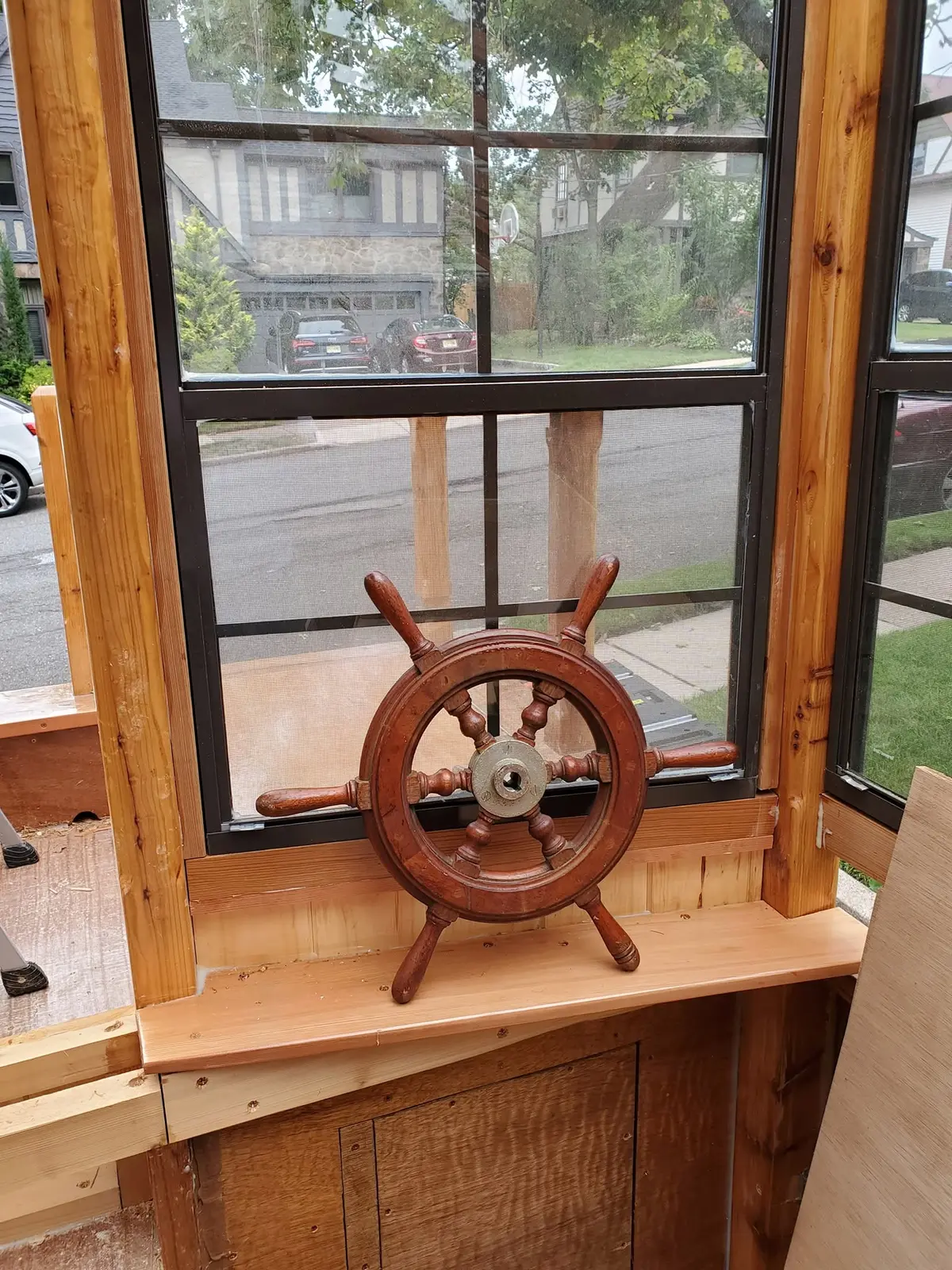
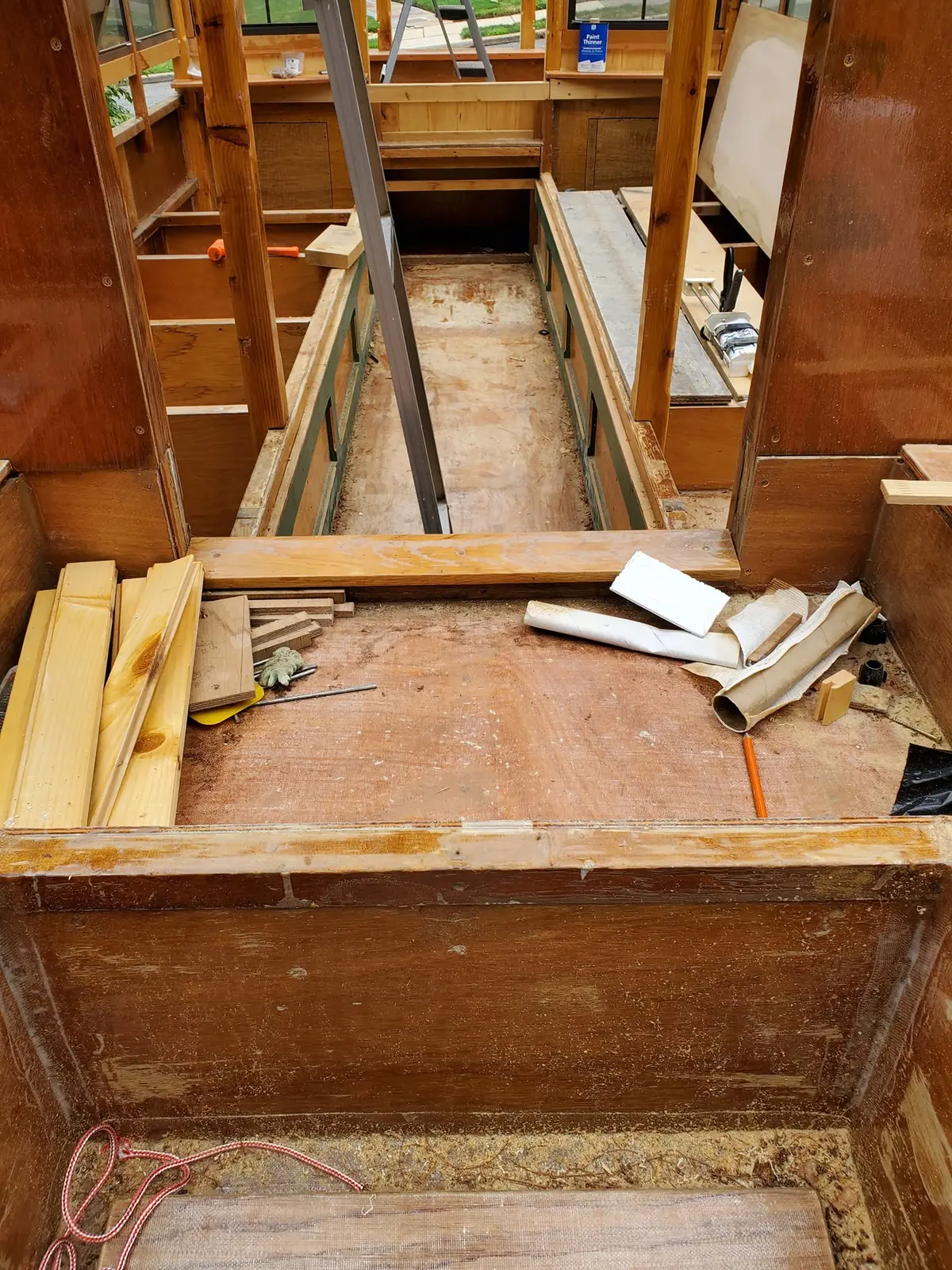
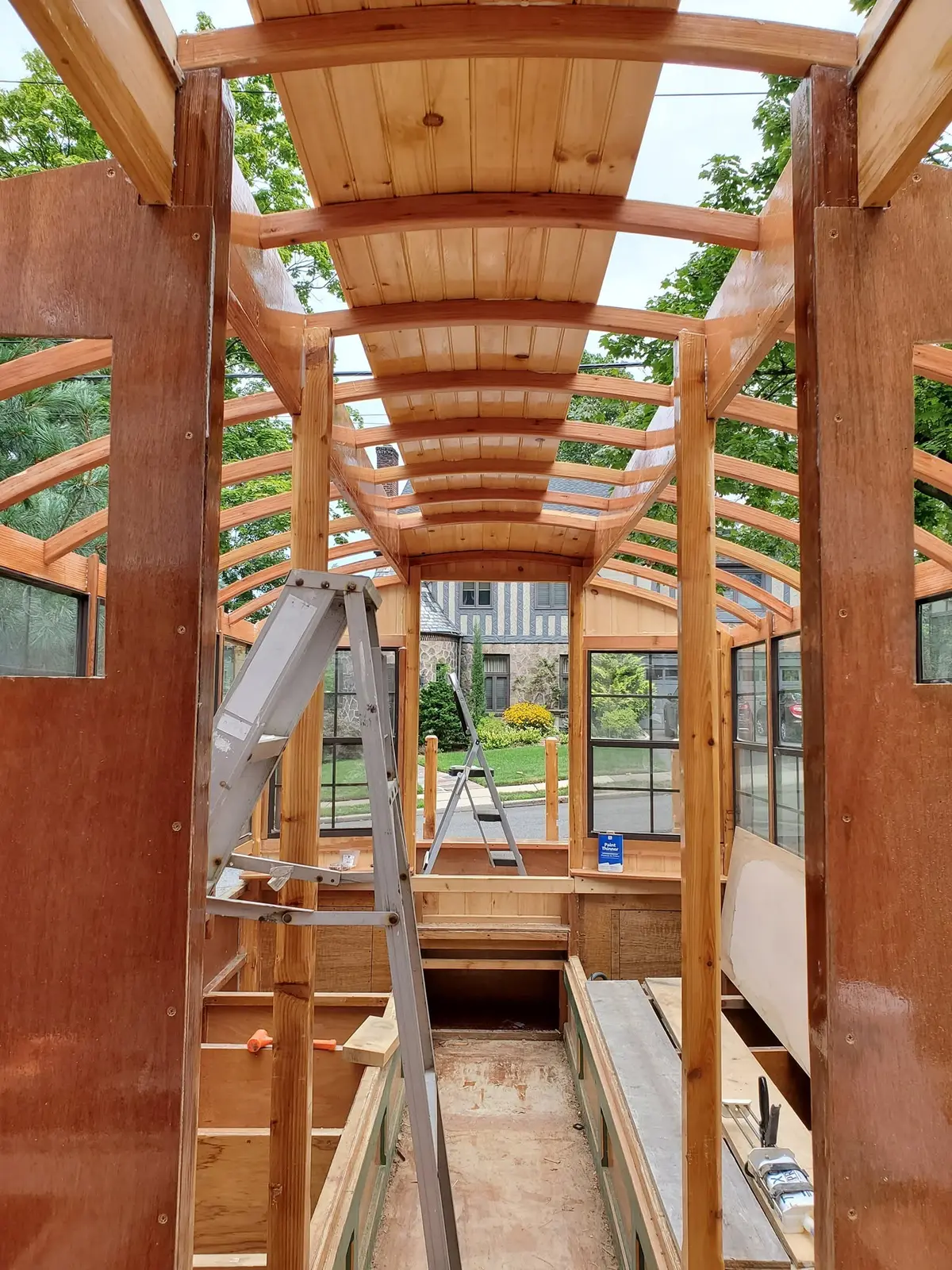
Houseboat update, Wednesday, August 14, 2019 -- Roofing on Jersey Girl progresses. Here's a series of photos to give an idea of what the inside will look like, from the motor well aft to the bow, and up to the roof. First is where the outboard motor will be, followed by the aft deck (which will also serve as an outdoor covered solar heated shower stall). Next, the door into the aft of the cabin. On the port (left) side will be the galley, equipped with small versions of stove, sink and refrigerator. Across the center aisle is space reserved for a head, with composting toilet. Forward of the two posts is the main cabin area, with setters along both sides. The seat sections will open two ways: out toward the center to create a queen-size bed, and up toward the side windows, for storage compartments and, on the port side, for a two-person dinette. Ahead of the forward cabin door will be the forward deck, with outside seating and more storage. There will be a few more refinements for creature comfort, which I will describe at a future time. This may have started out as a "shantyboat" in concept, but I must say it has evolved to at least "shanty chic," the waterborne version of "glamping." There's an additional picture showing where the helm will be, along with the salvage ship's wheel I was able to find.
As the summer is drawing to an end and cooler weather is closing in on Jersey Girl and...
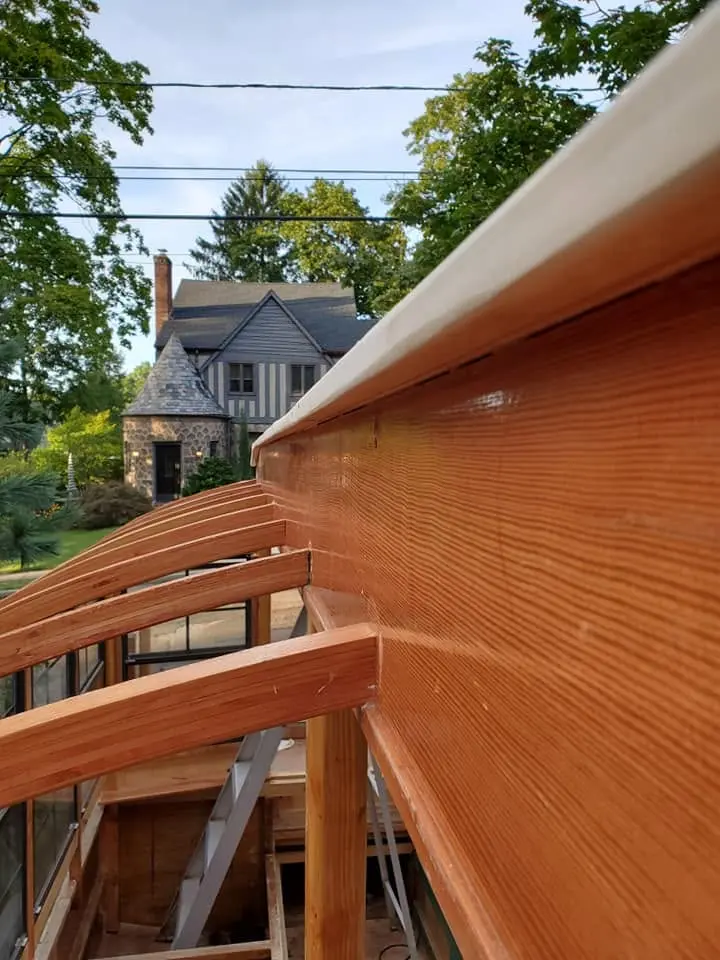
Houseboat update, Monday, August 26, 2019 -- As the summer is drawing to an end and cooler weather is closing in on Jersey Girl and me, I'm working hard to seal the cabin for the winter. As you can see, I have finished the roof planking on the port half and a little of the starboard half of the raised central portion of the roof. Before I finish the starboard side, I will use the openings for access to fill the topside grooves of the planking with thickened epoxy, then sand everything to a smooth surface in preparation for fiberglass. I'll finish the planking on the starboard side and smooth that as well. But before I start work on the two "shoulders," I will have to apply the fiberglass fabric, smooth that out and prime and paint the central section. Only then will I be able to treat the port and starboard shoulders the same way. I've included a photo of the neat little (1-inch) overhang along the port edge. I think it's a nice finishing touch.
Today's project will be to fill all the topside grooves between Jersey Girl's roof planks.
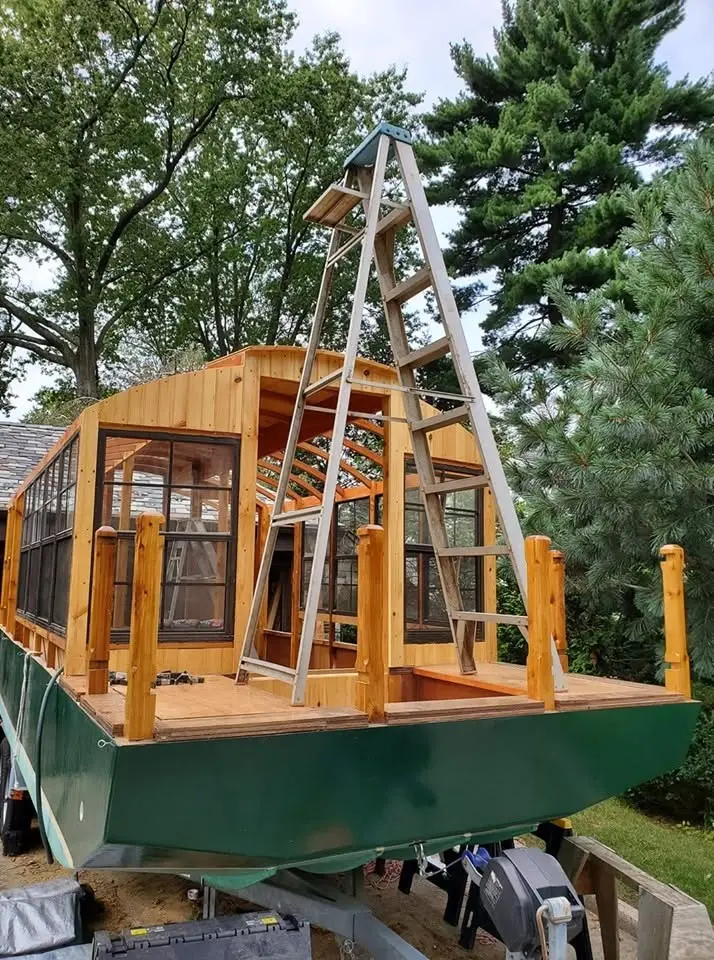
Houseboat update, Tuesday, August 27, 2019 -- Today's project will be to fill all the topside grooves between Jersey Girl's roof planks. I will be using a mixture of epoxy and colloidal silica powder to create a thickened putty. Before I can do that, I must make sure the roof is free of all the morning dew that has condensed on the surface. I give the anticipated warmth of the day a head start by toweling off standing water drops and puddles. The obvious question is how I managed to get the picture of the top surface of the roof. I could say, "skyhooks," and let it go at that, but that would be wrong. Here's how: a tall ladder, balanced between the seats on the forward deck. I don't recommend this for anyone with more than a sensible fear of heights -- or less than a sensible fear of heights, either, for that matter. One of these days, I really should invest in a decent drone with photo capability.
Today is shaping up as a day of scattered thunderstorms through the night, so no...
Houseboat update, Wednesday, August 28, 2019 -- Today is shaping up as a day of scattered thunderstorms through the night, so no actual work on Jersey Girl -- until tomorrow when a 10-day run of excellent building weather is forecast to start. In the meantime, I have been taking very seriously all the concerned comments from a number of observers that I am building failure into Jersey Girl's roof by fastening the planks down with epoxy and filling the topside grooves with more thickened epoxy, and planning to finish the top with fiberglass bedded in epoxy, followed by primer and paint on top of that. The concern is that because of the natural swelling and shrinkage of the wood over the course of the year, without the flexing ability of traditional caulk and a canvas cover, the grain of the wood itself would separate and split, leading to failure. So, after a night of sleepless worry, I called the gurus at Jamestown Distributors this morning and posed the problem to them. The short answer is that I will be fine doing just what I had planned. JD assures me that if the planks are all encapsulated by epoxy on both sides and all edges, and further sealed by epoxy and fiberglass on top, there will be no seasonal changes in moisture levels within the wood, and minimal expansion and contraction to worry about. Moreover, they said, the epoxy itself has a minimal ability to expand and contract with the wood. Finally, there is my own experience. More than 20 years ago, I built two cedar strip kayaks, sealed inside and out with fiberglass and epoxy applied directly to the wood. With regular maintenance, applying a fresh coat of varnish every couple of years, there has been absolutely no evidence of failure of the wood or delamination of the fiberglass, even though they are stored outside (under a roofed but open shelter) during the winter. With the patina of age and heavy use, they are even more beautiful now than they were when I built them. So, with thanks to all who have expressed concern, I have decided to complete Jersey Girl's roof as planned.
Nobody else here is logging a Jersey Girl yet.
See the boat.