Jim Norman's 20 foot houseboat, built in his northern New Jersey driveway from 2015 to 2021. The design started from Roy Schreyer's Dianne's Rose, stretched three feet and reworked into his own. Okoume plywood hull over sawn frames and bulkheads, a cabin of cedar posts and laminated roof beams sheathed in pine beadboard, and a fiberglassed arched roof with gull wing panels over the aft deck. Launched on the Hackensack River in May 2021, she now cruises Lake Hopatcong, where she took the Ladies' Choice award at the 2024 antique and classic boat show.
Make a book
Feed
The whole log, 191 entries and every photo,
laid out as a book to print, bind and keep.
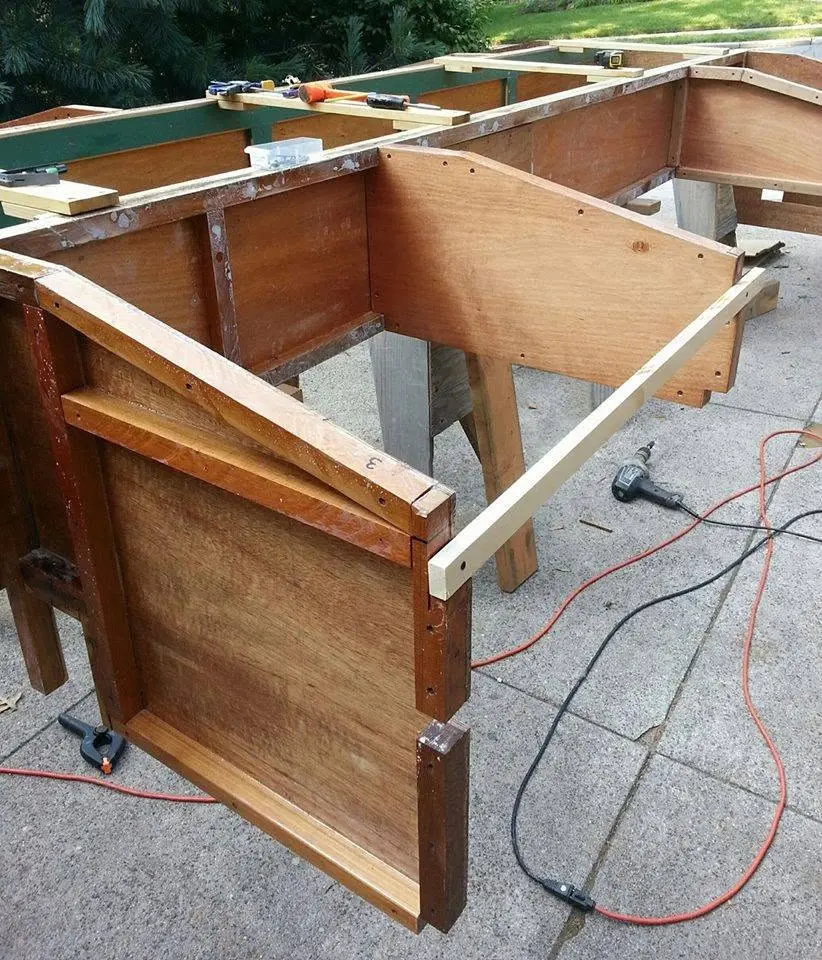
It's time to start adding the partial bulkheads, four on each side.
Aug. 10, 2017. It's time to start adding the partial bulkheads, four on each side. Unlike the full-beam (beam is the nautical term for width) bulkheads installed earlier, these shorties do not transect the central space between the two longitudinal frames in the area where the cabin will be. That's because we are keeping that space unobstructed to serve as an aisle so we can move about inside. But before I glue and screw these partial bulkheads in place I have to make sure they are square. In this case, I have decided to make the first partial bulkhead toward the aft end of the cabin 35 inches forward of the previously installed aft cabin full bulkhead. It's pretty easy to screw it into place at the inboard end, but it flops around, back and forth. How do I make sure that when the epoxy cures the assembly will be square to the frame? I put two pencil marks 35 inches apart on a scrap stick of wood (by now I have plenty of those) and temporarily screw it to the aft cabin bulk head and the new partial bulkhead. If the previously glued bulkhead is square (and it is), this partial bulkhead will be square when the glue sets. Boatbuilding, if nothing else, is an exercise in problem solving.
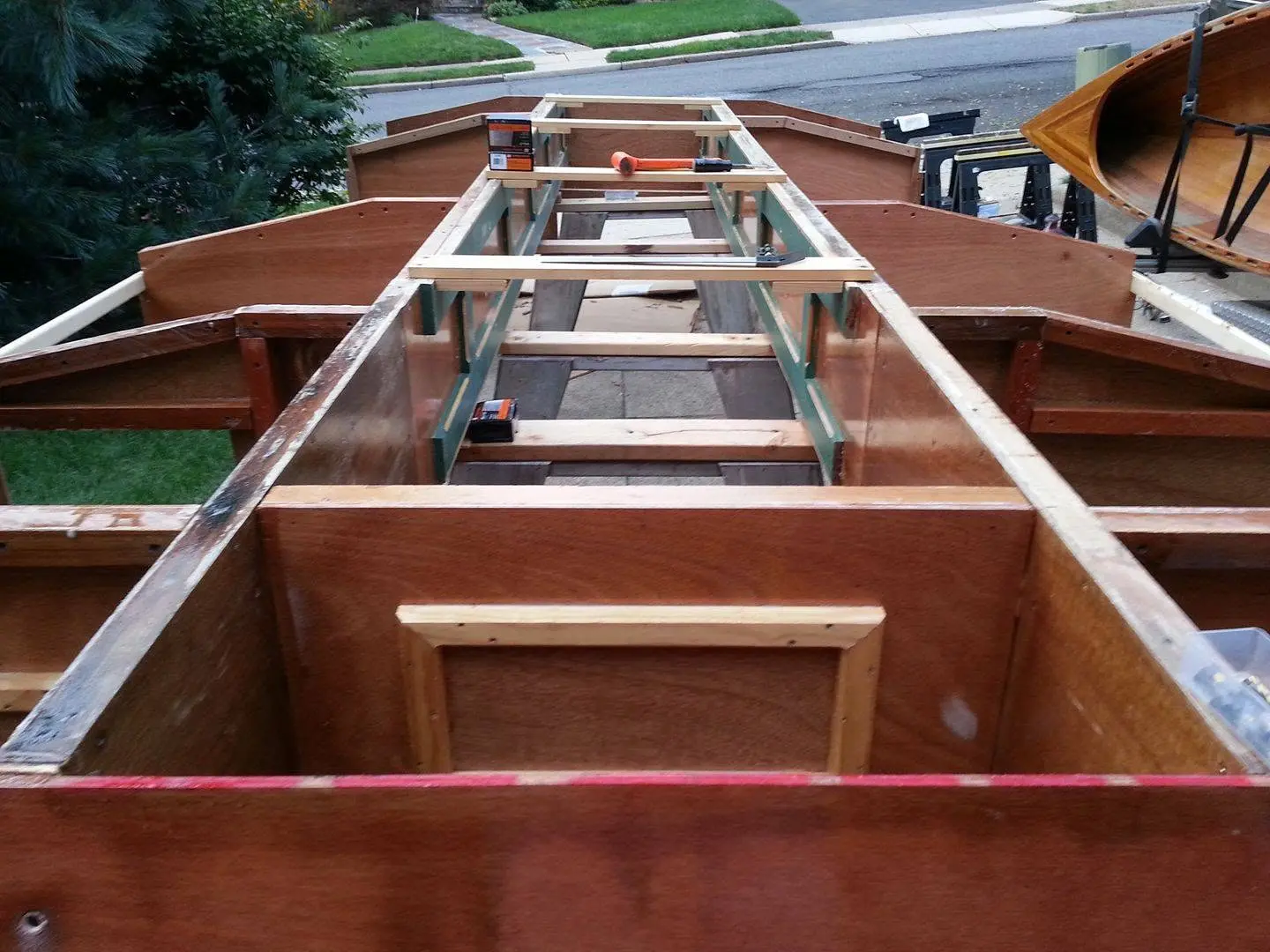
Quitting time, Aug. 10, 2017 -- That's it for today.
Quitting time, Aug. 10, 2017 -- That's it for today. The mosquitoes are having a feast, and I'm about due for a transfusion. I am four partial bulkheads away from a complete frame for the hull. I'll have to do a little planing to bevel around the bow and stern. At the joints where the pieces of wood intersect, I will have to lay in a "fillet" of thickened epoxy, and reinforce each joint with a strip of fiberglass tape. I hope to be ready to start sheathing the hull next week.
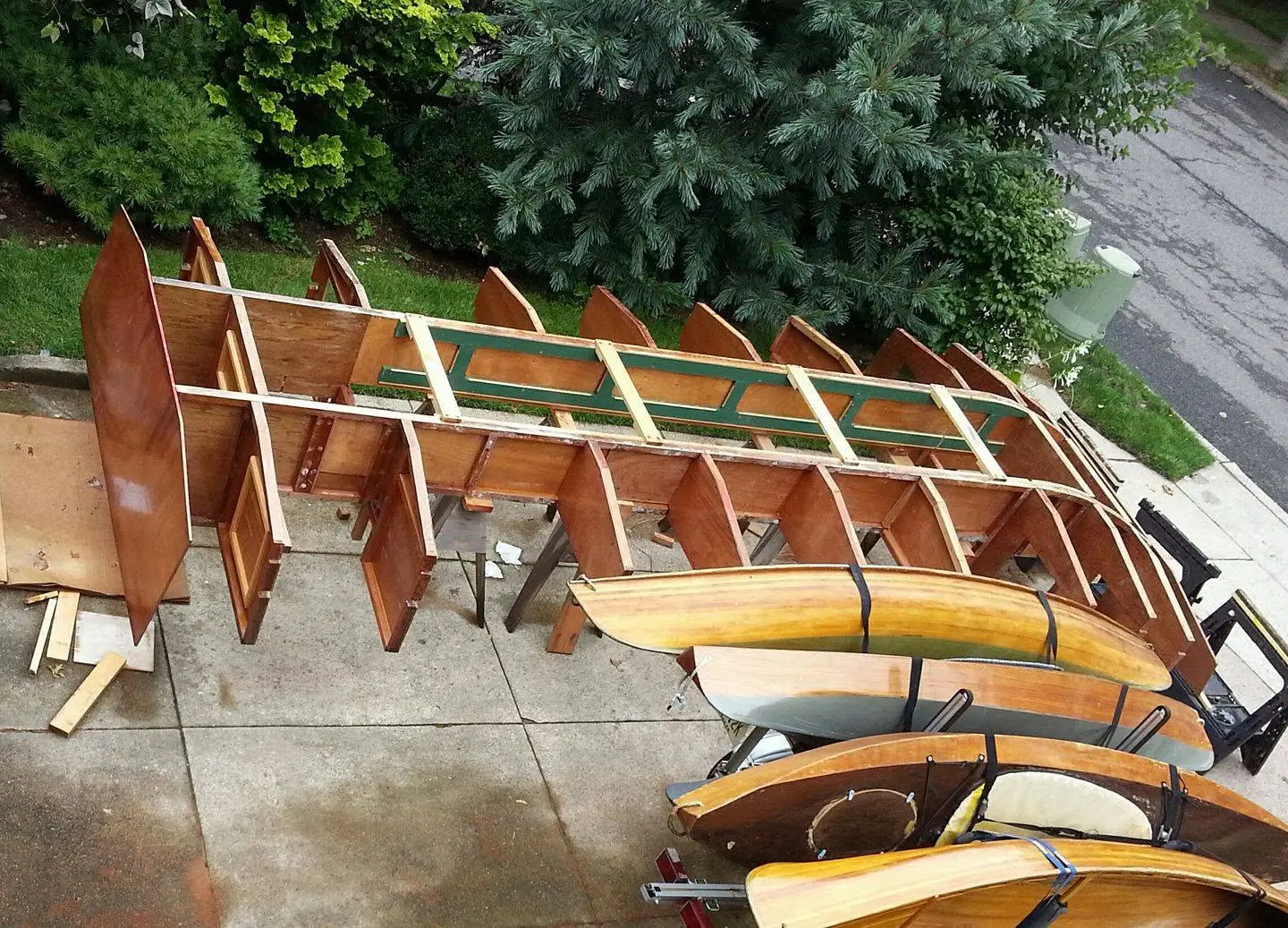
Aug. 15, 2017: A view from the bridge. Actually, from an upstairs window. All the framing is in place. Before I can start sheathing the hull with marine plywood, I will reinforce all the frame joints with fiberglass tape and epoxy, and plane down any high spots and shim any low spots. I will also go over all my work carefully to make sure I have not left behind any steel sheet rock screws that I used as temporary clamps. They all need to be replaced with non-rusting silicon bronze screws. Each will be dipped in epoxy before being driven home, to make sure they stay in place over the life of the boat, and to block any possible path for water intrusion and eventual rot.
I have decided to solve a few problems at one time.
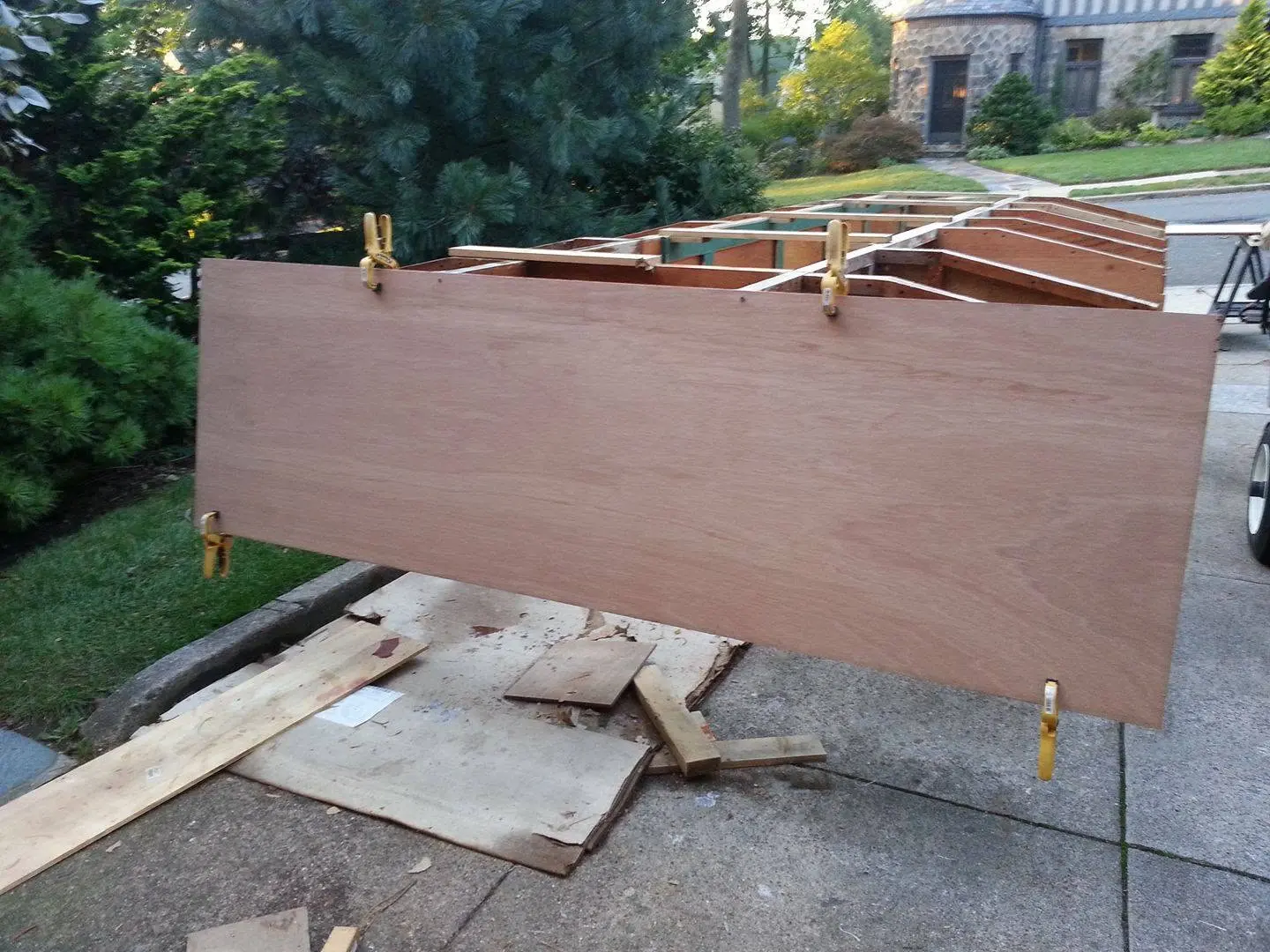
Sept. 7, 2017: I have decided to solve a few problems at one time. The problems: my dissatisfaction over the ugly dark stains from water intrusion under the epoxy finish in the transom, together with the expensive okoume's totally boring grain pattern, and my feeling that I wanted to thicken and stiffen the transom to be able to support a much larger motor than the design calls for. Solution: face the transom with half-inch laminates, inside and out, of much less expensive lauan marine plywood. I believe it's better quality plywood, it has a much more interesting grain, and when I finish, the transom will be an inch and a half thick. Here, I've hung a piece of lauan, fixed temporarily with two screws and four clamps, so I can accurately trace the shape to match the existing transom. I'll cut it tomorrow, then apply an epoxy finish before gluing it down permanently. I am pretty sure it will be a vast improvement. We shall see.
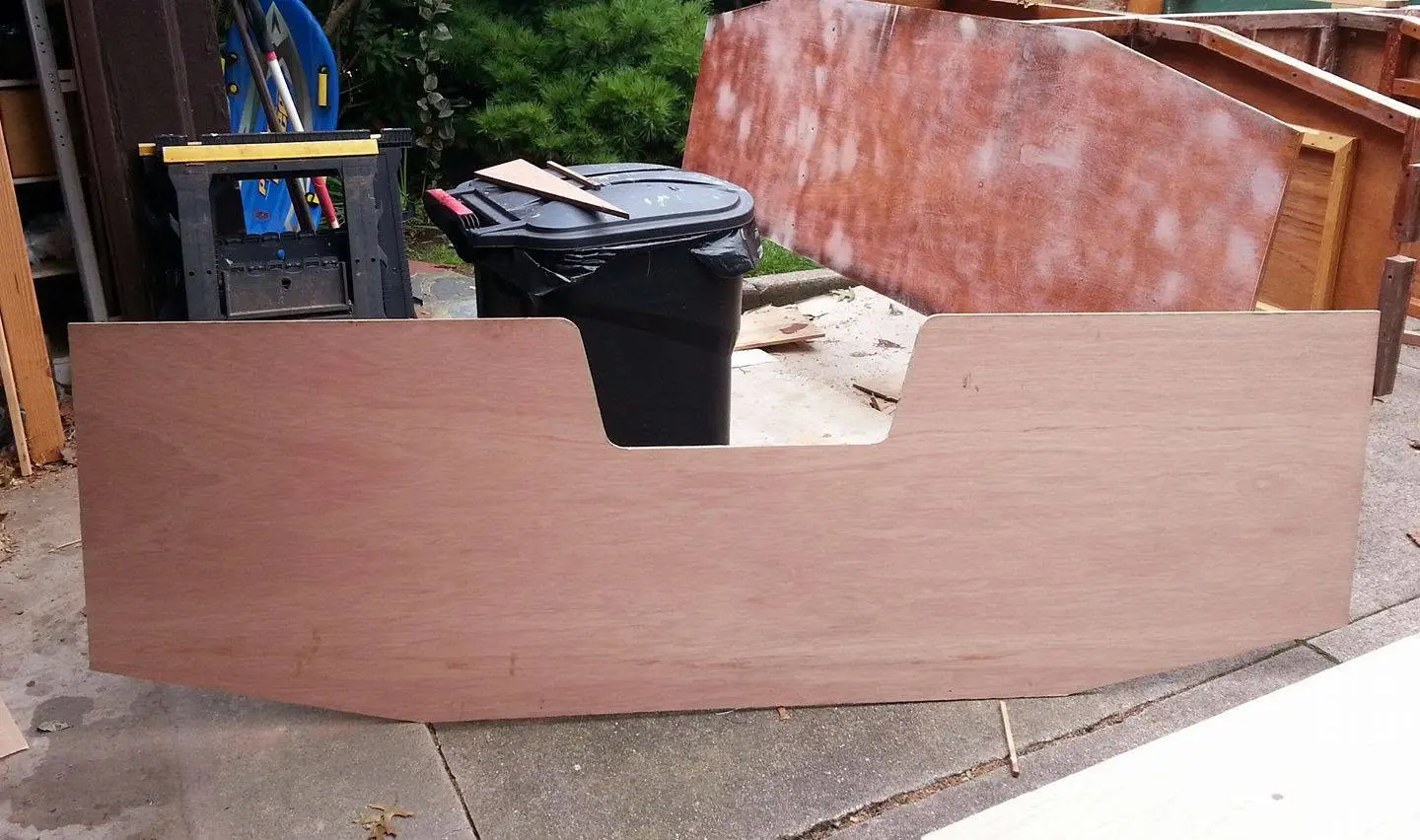
Sept. 8, 2017: This will be the new outer face of the transom. The center cut-out is to accommodate the outboard motor, which will be either a 20 or 25 H.P. long-shaft. I'm open to brand recommendations from anyone with experience. I'm also beginning to explore the possibility of an electric outboard motor, powered by batteries to be charged conventionally at dockside or by roof-mounted solar panels. It looks like this will be a much more expensive installation, and the weight of the batteries may be a problem. But a decision is a long way off, and it's just possible that by the time I am ready the price will come down and technology will deliver lighter batteries. But it's nice to think about.
Nobody else here is logging a Jersey Girl yet.
See the boat.