Jim Norman's 20 foot houseboat, built in his northern New Jersey driveway from 2015 to 2021. The design started from Roy Schreyer's Dianne's Rose, stretched three feet and reworked into his own. Okoume plywood hull over sawn frames and bulkheads, a cabin of cedar posts and laminated roof beams sheathed in pine beadboard, and a fiberglassed arched roof with gull wing panels over the aft deck. Launched on the Hackensack River in May 2021, she now cruises Lake Hopatcong, where she took the Ladies' Choice award at the 2024 antique and classic boat show.
Make a book
Feed
The whole log, 191 entries and every photo,
laid out as a book to print, bind and keep.
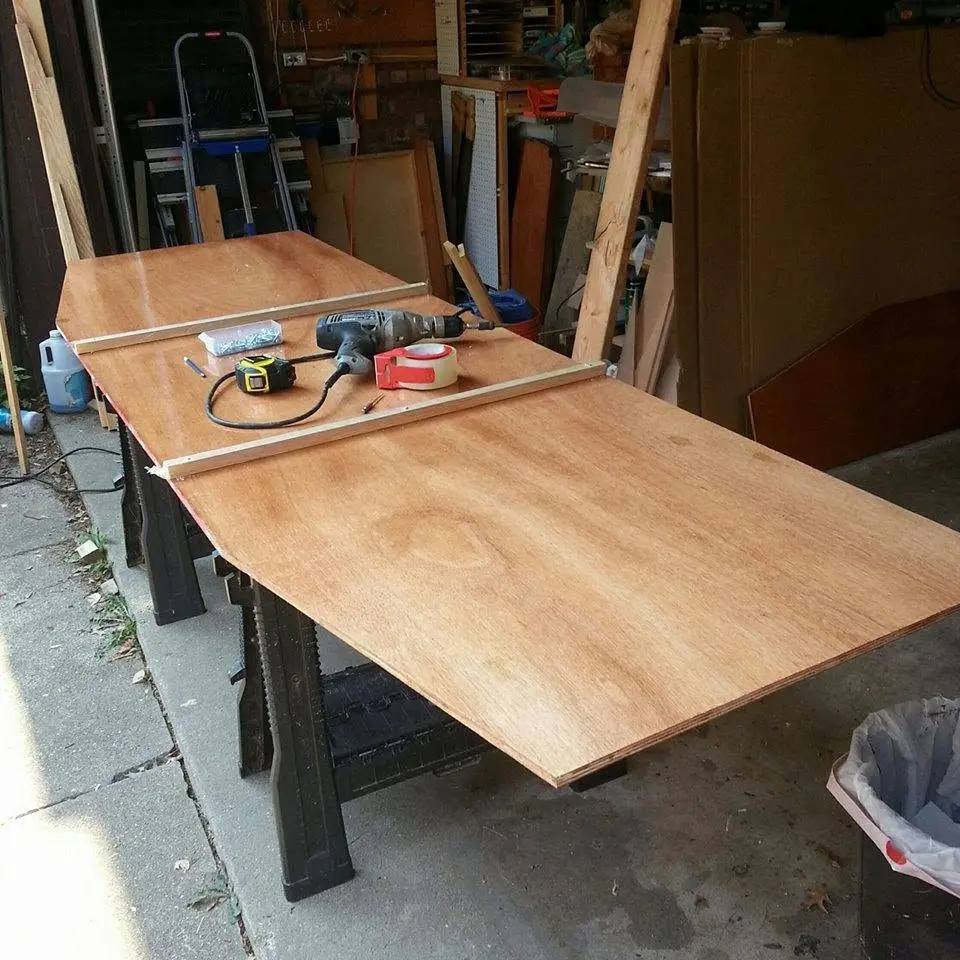
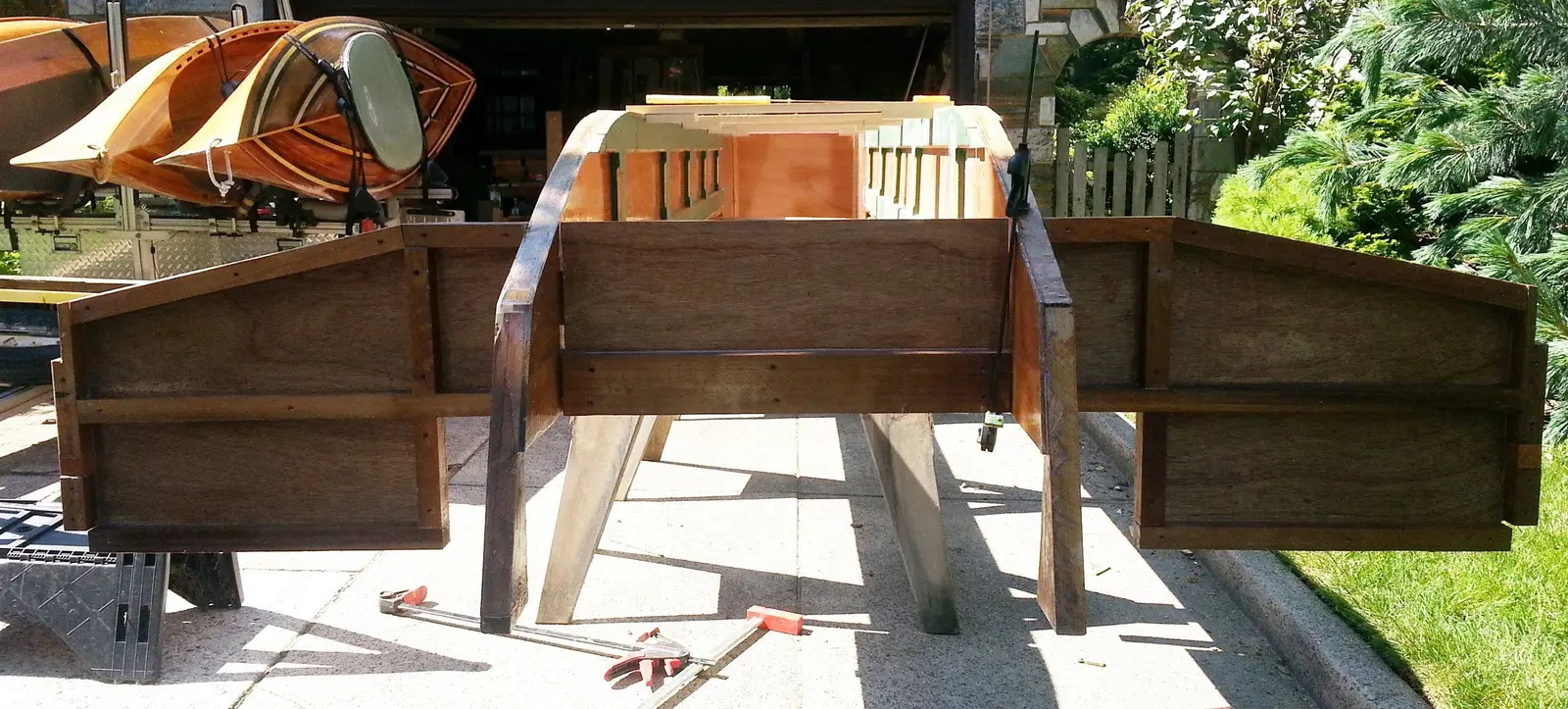
I'm preparing the transom to be installed on the stern.
July 19, 2017. I'm preparing the transom to be installed on the stern. I've screwed down two temporary spacer strips making sure to use screws long enough to hold the half-inch plywood securely but short enough not to break the surface on the opposite side, which will show. Also, I've wrapped the strips in package-sealing tape, so any squeeze-out of epoxy will not stick to them and I will be able to remove them easily. Yes, I measured three times, three different ways. Outside edge to outside edge of the spacing strips, 28 1/2 inches. Centerline of the transom to outside edge of each strip, 14 1/4 inches. Outside edge of each strip to outside edges of transom, 32 1/4 inches. Total, 93 inches, equaling width of transom. Check. I sure don't want to screw up now!
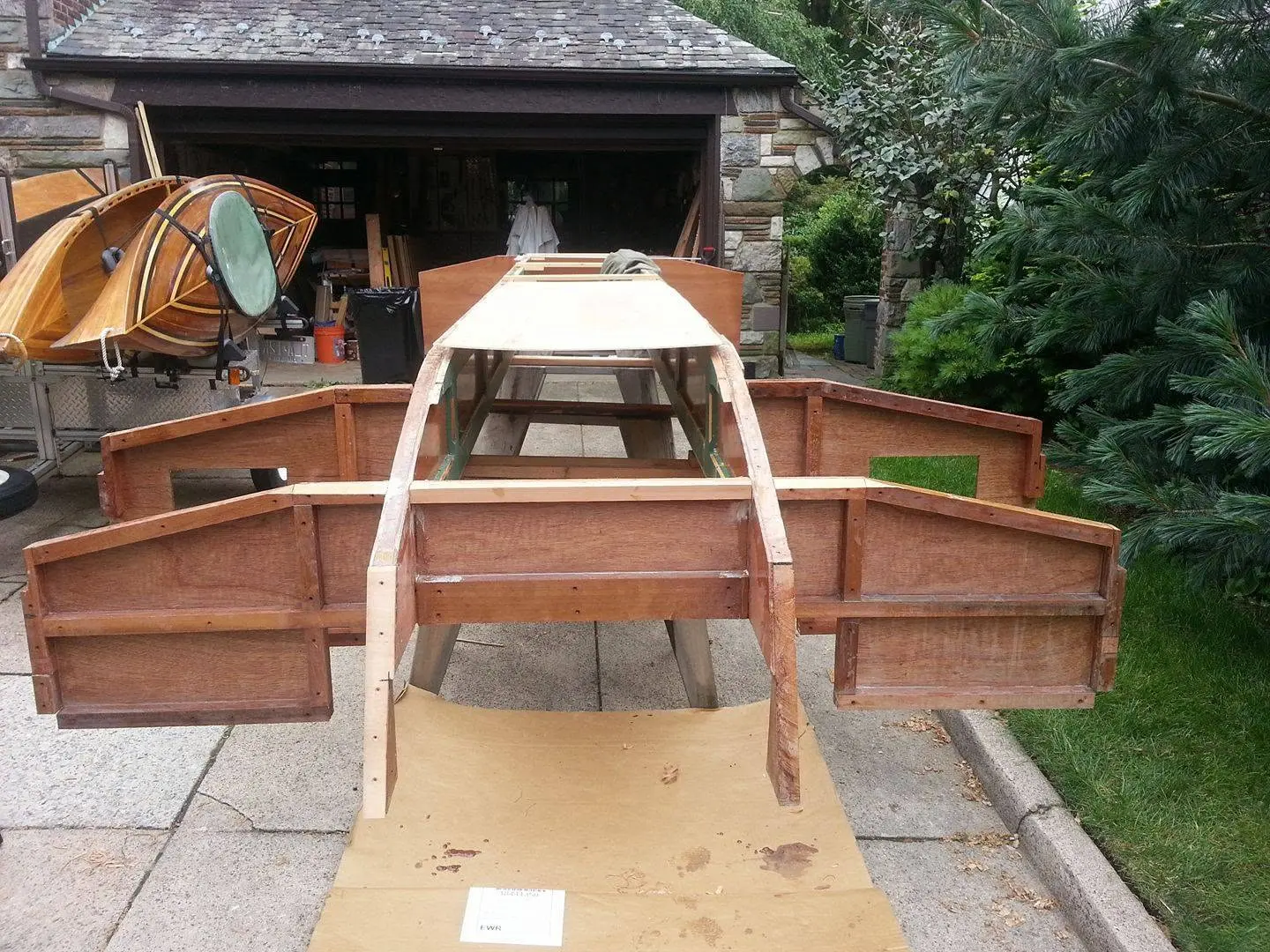
Now, moving forward to the bow, I'm fitting foremost full width bulkhead.
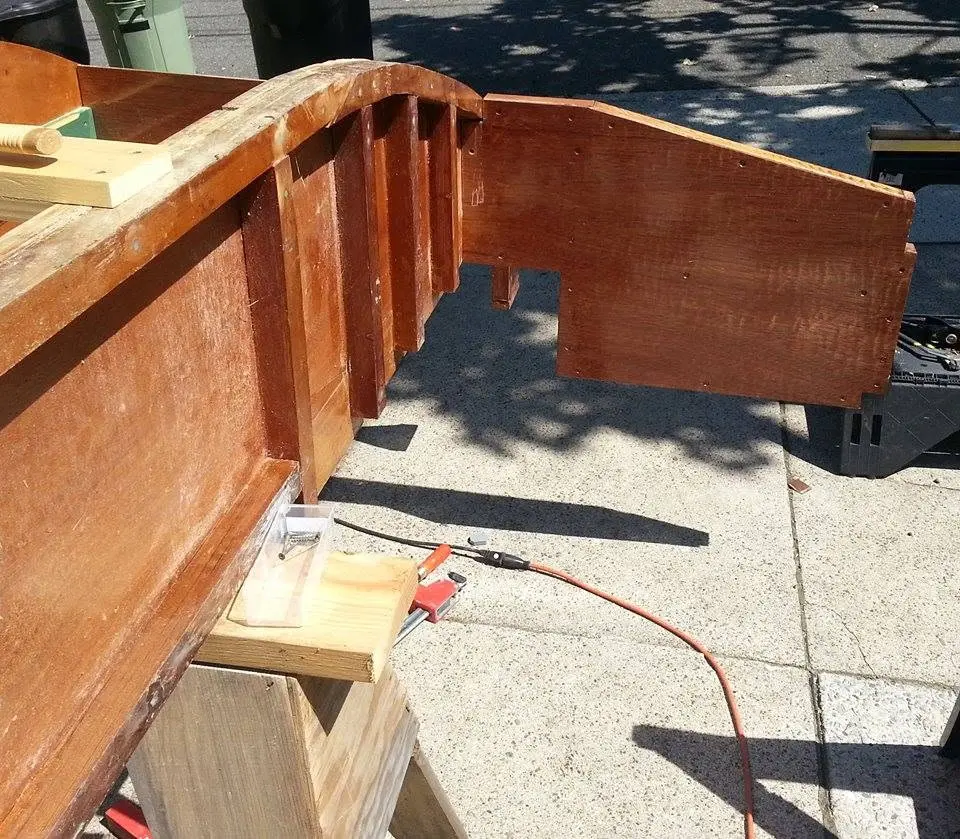
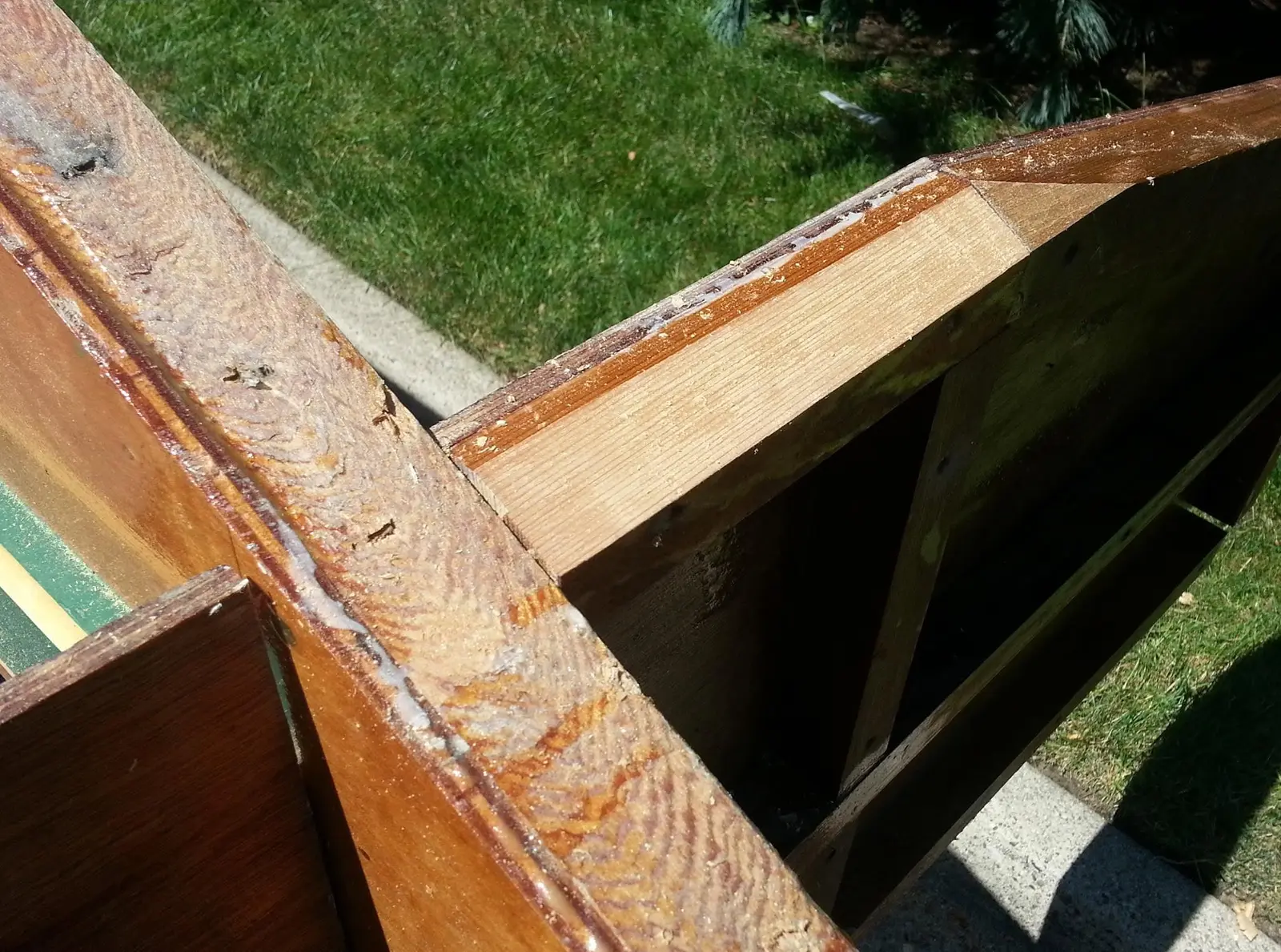
July 21, 2017. Now, moving forward to the bow, I'm fitting foremost full width bulkhead. This begins the creation of the slotted "egg crate" construction method used for this boat.You can see that when the bulkhead is in place along the curve of the bow, it will need some planing to make its bottom timber conform so that the plywood bottom panel can be bent to the proper shape, when it's time to do that. The third picture shows what it looks like after I have planed an angle matching the curve of the bow. And the fourth picture gives you and idea of the placement of the bulkhead joining the two long frames. (In the background, you can see a trailer loaded with some of the family kayaks that I've built.)
July 25, 2017. The mid-bow bulkhead went in today. Tomorrow, I will make some adjustments and put in the forward cabin bulkhead. I find I have to keep checking for square as I go along, and I have devised a great way to do that reliably and easily. The sheet of cheap quarter-inch plywood sitting on top of the work (actually, the bottom, but it's upside-down) is my squaring tool. I just line it up parallel with both of the longitudinal side frames and put the short edge where I want to install a lateral bulkhead. I mark on both sides and enjoy the confidence that it will be square.
I am preparing for the dry fit of the stern bulkhead, the one just forward of the transom.
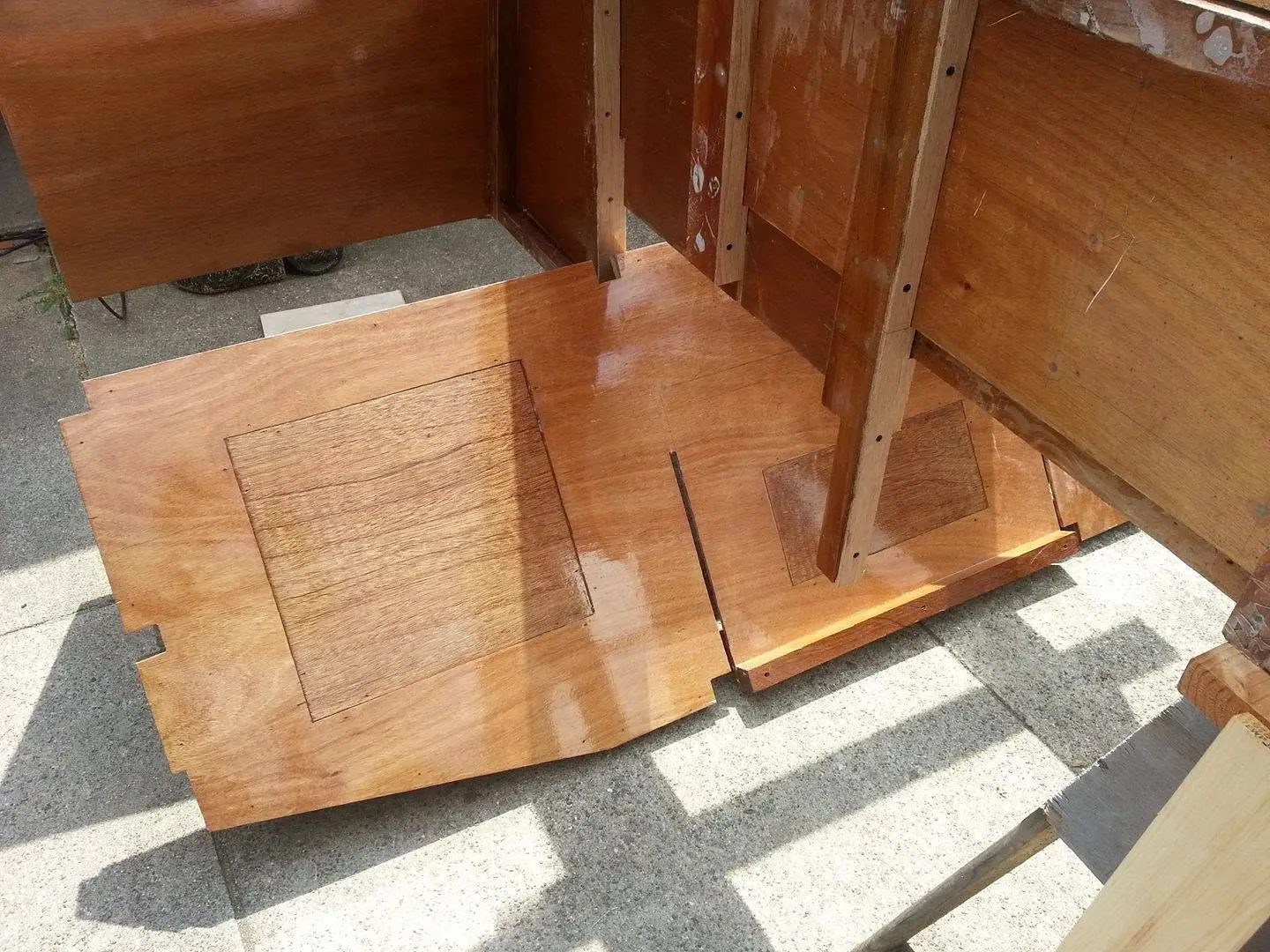
July 26, 2017. I am preparing for the dry fit of the stern bulkhead, the one just forward of the transom. Actually, it's the second dry fit for this component. The first time around I found I had to trim a bit here and there to make it fit. I think I cut and ground and chiseled away all the offending bits, but am I certain? No, it doesn't fit until I see it fits. Can you imagine spreading epoxy with a working life of about a half-hour, and then discovering the piece doesn't fit? What a mess. So, I have to dry fit every piece, screw it together, and if any adjustments are necessary dry fit it again. Essentially, I am building this boat twice. In some places, three times!
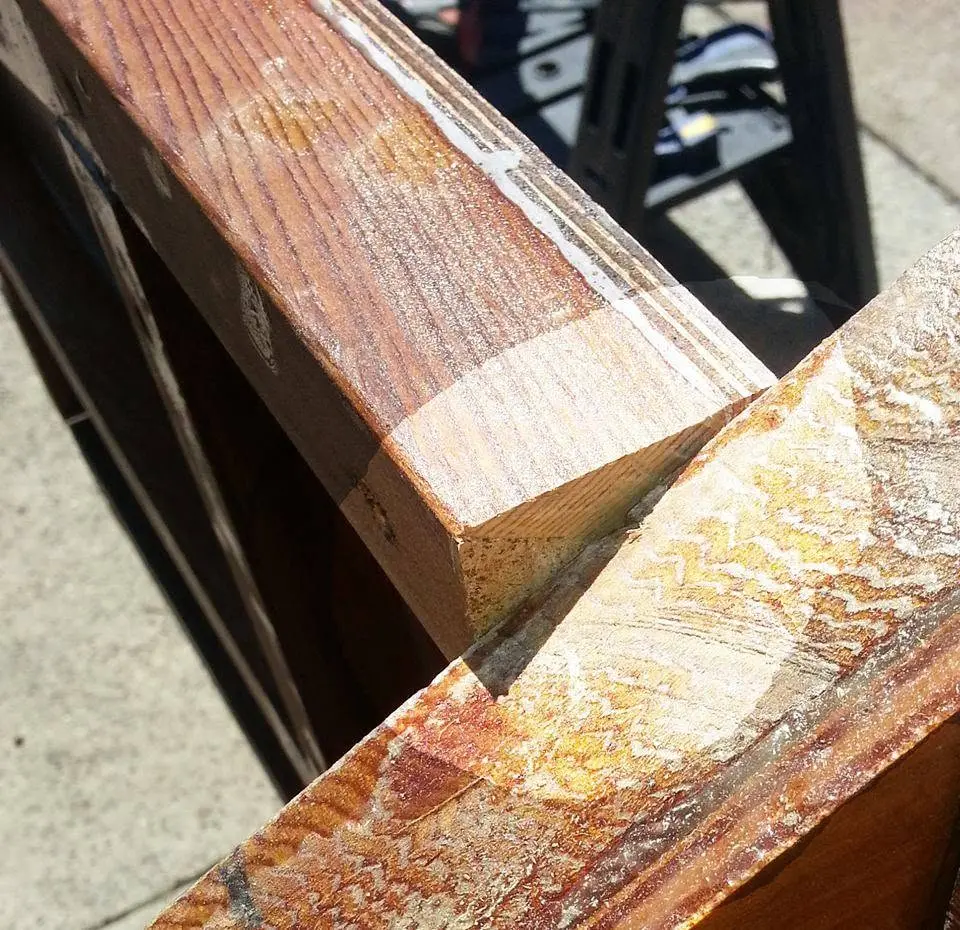
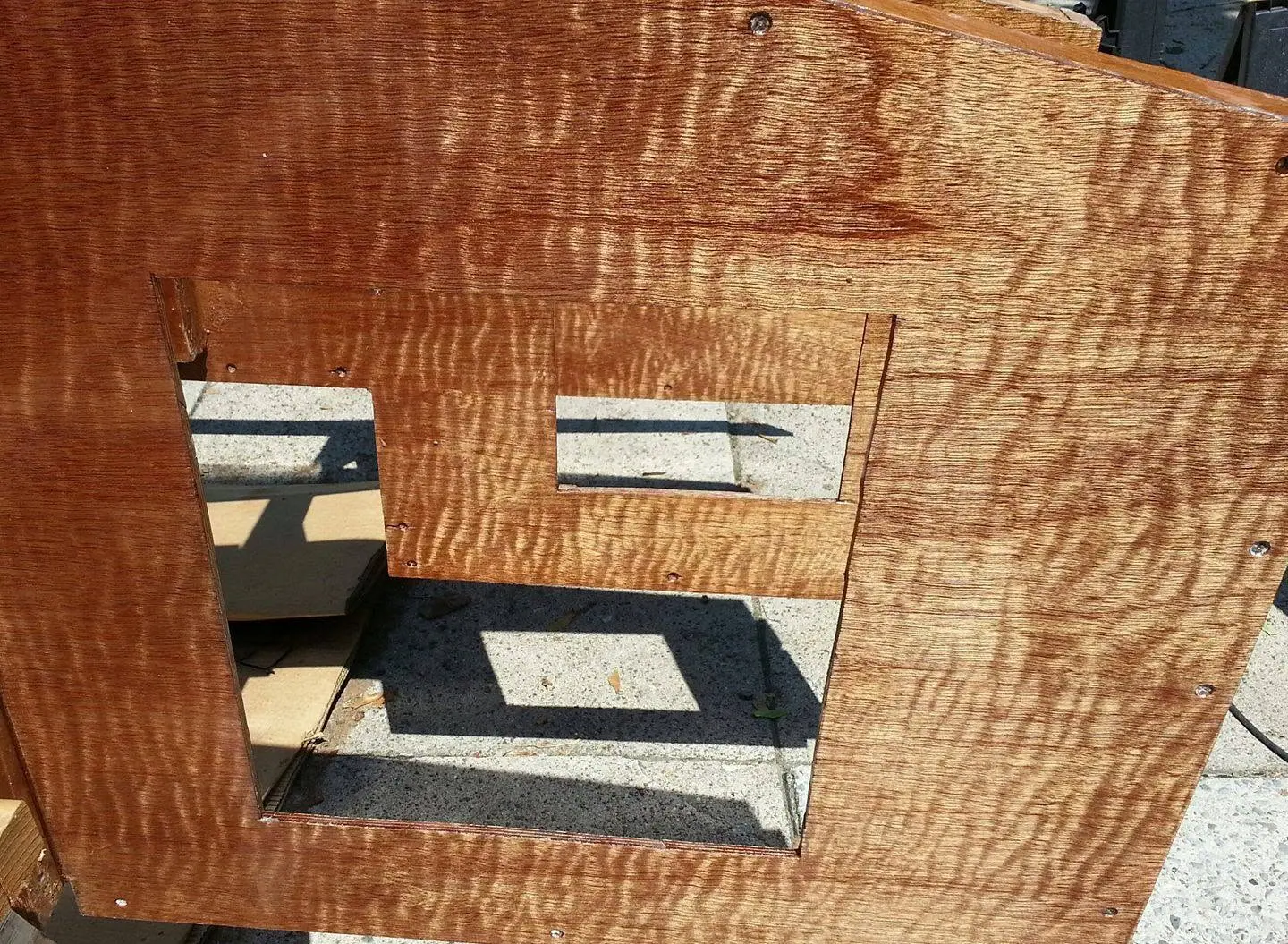
August 9, 2017. Houseboat footnote. Take a gander at the figure of this grain! So here's a brief peregrination on the relative merits of okoume and lauan marine plywood for boatbuilding. "You don't build boats with lauan," more than one boat-building professional has sniffed at me. "You use okoume. Only if you want the boat to stay on top of the water." So of course I started out with okoume, made in Holland from an African hardwood that -- as I understand it, and I could be wrong -- is related to mahogany. And it carries a certification from Lloyd's of London saying it is waterproof even if the water is boiling. (Which is good to know in a time of climate change, I guess.) At $150 a sheet, this is expensive stuff. I went for it. But lately, I have had trouble sourcing okoume locally. "We are selling rotary-cut instead of okoume now," the folks at the yard said. Rotary-cut what? I asked. Long pause, then a sotto voce response: "Lauan. But it's certified." Which it is, although only the adhesive between the plies and not the material itself. At $75 a sheet, it's a bargain, I hope. So i bought it. So far, it's a pleasure to work with. It has more plies of more uniform thickness than okoume. The grain figure and color are what you see here. As for water intrusion after epoxy sealing, there is none. That has been a problem with okoume. So far, I like it much better. The second picture shows Okoume, with its long, rather boring grain. See those vertical striations? That's water intrusion. It's dried out now, but the stain is permanent.
Nobody else here is logging a Jersey Girl yet.
See the boat.